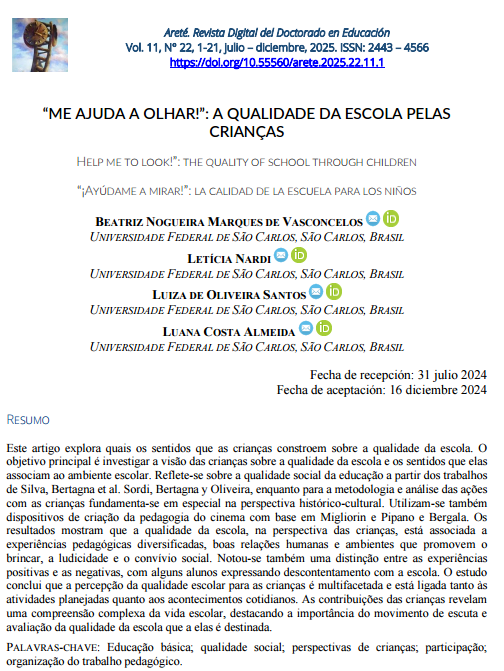
“¡Ayúdame a mirar!”: la calidad de la escuela para los niños
DOI:
https://doi.org/10.55560/arete.2025.22.11.1Palabras clave:
Educación Básica, Calidad Social, Perspectivas de los Niños, Participación, Organización del Trabajo PedagógicoResumen
Este artículo explora los significados que los niños construyen sobre la calidad escolar. El objetivo principal es investigar las opiniones de los niños sobre la calidad escolar y los significados que asocian al ambiente escolar. Las reflexiones sobre la calidad social de la educación se basan en los trabajos de Silva, Bertagna et al. Sordi, Bertagna y Oliveira, mientras que la metodología y el análisis de las acciones con los niños se basan especialmente en la perspectiva histórico-cultural. También se utilizan dispositivos creativos de la pedagogía del cine basados en Migliorin y Pipano y Bergala. Los resultados muestran que la calidad de la escuela, desde la perspectiva de los niños, está asociada a experiencias pedagógicas diversificadas, buenas relaciones humanas y ambientes que promuevan el juego, la lúdica y la interacción social. También se distingue entre experiencias positivas y negativas, y algunos alumnos expresan insatisfacción con la escuela. El estudio concluye que la percepción que tienen los niños de la calidad de la escuela es polifacética y está vinculada tanto a las actividades planificadas como a los acontecimientos cotidianos. Las aportaciones de los niños revelan una comprensión compleja de la vida escolar y ponen de relieve la importancia de escuchar y evaluar la calidad de la escuela a la que asisten.
Descargas
Citas
Barros, F. (2009). Cadê o brincar?: da Educação Infantil para o Ensino Fundamental. Editora UNESP.
Bergala, A. (2008). A Hipótese-Cinema: pequeno tratado de transmissão do cinema dentro e fora da escola. Booklink.
Berger, J. (1999). Modos de ver. Rocco.
Bergson, H. (1999). Matéria e memória (P. Neves, Trad., 2.a ed.). Martins Fontes.
Bertagna, R. H. (2020). Avaliação da qualidade social da escola pública: delineamentos de uma proposta referenciada na formação humana. Políticas Educativas–PolEd. https://seer.ufrgs.br/index.php/Poled/article/view/107364
Bondioli A. (2004). O projeto pedagógico da creche e a sua avaliação: a qualidade negociada. Autores Associados.
Bustamante, G. O. (2004). Por uma vivência escolar lúdica. In G. M. Schuartz (Org.), Dinâmica lúdica: novos olhares (p. 61). Manole.
Charlot, B. (2018). Qualidade social da escola pública e formação dos docentes. Revista Espaço Pedagógico, 12(2), 39-48. https://doi.org/10.5335/rep.v12i2.7977
Coutinho, L. G., Carneiro, C., & Salgueiro, L. M. (2018). Vozes de crianças e adolescentes: o que dizem da escola? Psicologia Escolar e Educacional, 22(1), 185-193. https://doi.org/10.1590/2175-35392018014739
Cruz, S. H. V., & Cruz, R. C. A. (2015). A perspectiva de crianças sobre a creche. Eventos Pedagógicos, 6, 155.
Cruz, S. H. V., & Schramm, S. M. de O. (2019). Escuta da criança em pesquisa e qualidade da Educação Infantil. Cadernos de Pesquisa, 49(174), 16-35. https://doi.org/10.1590/198053146035
Elali, G. A. (2003). O ambiente da escola: uma discussão sobre a relação escola-natureza em educação infantil. Estudos de Psicologia, 8, 309-319.
Freitas, L. C. (2005). Qualidade negociada: avaliação e contra-regulação na escola pública. Educação & Sociedade, 26, 911-933. https://doi.org/10.1590/S0101-73302005000300010
Frias, R., Diniz, D., & Carvalho, N. (2023). Estaremos prontos para a escuta das crianças? Childhood & Philosophy, 19. https://doi.org/10.12957/childphilo.2023.76289
Galeano, E. (2015). O Livro dos Abraços. L&PM.
Góes, M. C. R., & Cruz, M. N. (2006). Sentido, significado e conceito: notas sobre as contribuições de Lev Vigotski. Pro-posições, 17(2), 31-45.
Ibiapina, I. M. L. M., & Ferreira, M. S. (2005). A pesquisa colaborativa na perspectiva sócio-histórica. Linguagens, Educação e Sociedade, 12, 26-38. https://periodicos.ufpi.br/index.php/lingedusoc/article/download/1569/1413
Laplane, A. L. F., & Botega, M. B. S. (2010). A mediação da cultura no desenvolvimento infantil: televisão e alimentação na vida quotidiana das famílias. In A. L. B. Smolka & A. L. H. Nogueira (Eds.), Questões de desenvolvimento humano, práticas e sentidos (pp. 13-31). Mercado de Letras.
Migliorin, C., & Pipano, I. (2019). Cinema de brincar. Relicário.
Mól, S. C., Lino, K. de L., Vasconcelos, J. de M., & Lima, M. P. dos S. (2024). O brincar no Ensino Fundamental: para além do (neo)produtivismo e do salvacionismo. Revista HISTEDBR On-line, 24. https://doi.org/10.20396/rho.v24i00.8668015
Pereira, L. H. P. (2015). Corporeidade e ludicidade nas séries iniciais do Ensino Fundamental: crenças, dúvidas e possibilidades. Educação, 40(3), 697-710. https://doi.org/10.5902/198464449225
Silva, M. A. (2009). Qualidade social da educação pública: algumas aproximações. Cadernos Cedes, 29, 216-226. https://doi.org/10.1590/S0101-32622009000200005
Sirgado, A. P. (2000). O social e o cultural na obra de Vigotski. Educação e Sociedade, 21(71), 45-78. https://doi.org/10.1590/S0101-73302000000200003
Smolka, A. L. B. (1993). Construção de conhecimento e produção de sentido: significação e processos dialógicos. Temas em Psicologia, 1(1), 7-15.
Smolka, A. L. B. (1995). A prática discursiva na sala de aula: uma perspectiva teórica e um esboço de análise. Cadernos Cedes, 35, 51-65.
Smolka, A. L. B. (2009). Criação e imaginação. In L. S. Vigotsky, Imaginação e criatividade na infância (pp. 11-18). Ática.
Sordi, M. R. L., Bertagna, R. H., & Oliveira, S. B. de. (2018). Qualidade da escola pública e as políticas neoliberais: que caminhos os estudantes sinalizam? Políticas Educativas–PolEd. https://seer.ufrgs.br/index.php/Poled/article/view/87295
Sordi, M. R. L., & Freitas, L. C. (2013). Responsabilização participativa. Retratos da escola, 7(12), 87-99.
Toassa, G. (2020). Um estudo sobre o conceito de sentido e a análise semântica da consciência em L. S. Vigotski. Cadernos CEDES, 40(111), 176-184. https://doi.org/10.1590/CC.225902
Veiga, I. P. A. (Org.). (1995). Projeto político-pedagógico da escola: uma construção possível (23.a ed.). Papirus.
Vigotsky, L. S. (2000). Manuscrito de 1929. Educação & Sociedade, 21, p. 21-44.
Vigotsky, L. S. (2003). Psicología pedagógica. Martins Fontes.
Vigotsky, L. S. (2007). A formação social da mente: os desenvolvimentos dos processos psicológicos superiores (7.a ed.). Martins Fontes.
Vigotsky, L. S. (2009a). A construção do pensamento e da linguagem (2.a ed.). Martins Fontes.
Vigotsky, L. S. (2009b). Imaginação e criação na infância: ensaio psicológico (Z. Prestes, Trad., A. L. Smolka, Apres. e Coment.). Ática.
Publicado
Cómo citar
Número
Sección
Licencia
Derechos de autor 2025 Beatriz Nogueira Marques de Vasconcelos, Letícia Nardi, Luiza de Oliveira Santos , Luana Costa Almeida

Esta obra está bajo una licencia internacional Creative Commons Atribución-NoComercial-CompartirIgual 4.0.
Esta revista provee acceso libre, inmediato a su contenido bajo el principio de que hacer disponible gratuitamente la investigación al público, lo cual fomenta un mayor intercambio de conocimiento global.
Los autores que publican en Areté, Revista Digital del Doctorado en Educación, están de acuerdo con los siguientes términos:
- Los autores conservan los derechos de autor y garantizan a la revista el derecho de ser la primera publicación del trabajo, al igual que licenciado bajo una Creative Commons Attribution License que permite a otros compartir el trabajo con un reconocimiento de la autoría del trabajo y la publicación inicial en esta revista.
- Los autores pueden establecer por separado acuerdos adicionales para la distribución no exclusiva de la versión de la obra publicada en la revista (por ejemplo, situarlo en un repositorio institucional o publicarlo en un libro), con un reconocimiento de su publicación inicial en esta revista y no se use para fines comerciales.
- Los contenidos e imágenes que se incluyen en los artículos son responsabilidad del autor/es. Areté, Revista Digital del Doctorado en Educación, no se hace responsable de la información incluida en ellos.
- Los autores están de acuerdo con la licencia de uso utilizada por la revista, con las condiciones de auto-archivo y con la política de acceso abierto.
- Se permite a los autores difundir electrónicamente (por ejemplo, en repositorios institucionales o en su propio sitio web) la versión publicada de sus obras, ya que favorece su circulación y difusión más temprana y con ello un posible aumento en su citación y alcance entre la comunidad académica.
- En caso de reutilización de las obras publicadas, debe mencionarse la existencia y especificaciones de la licencia de uso, además de mencionar la autoría y fuente original de su publicación.