Scientific peer review at a crossroads: Tensions and challenges
Keywords:
: peer review, ethics, artificial intelligence, scholarly publishing, editorial processAbstract
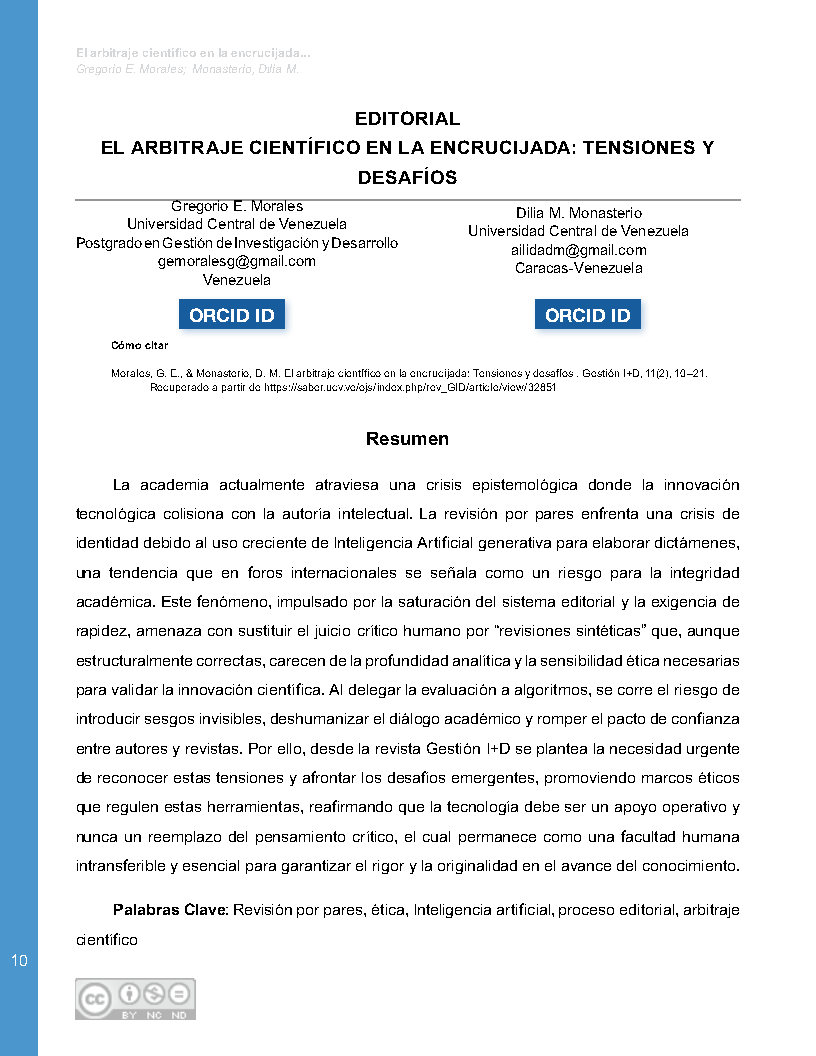
Academia is currently experiencing an epistemological crisis in which technological innovation collides with intellectual authorship. Peer review is facing a crisis of identity due to the growing use of generative artificial intelligence to produce evaluation reports, a trend that international academic forums have identified as a potential threat to research integrity. Driven by the saturation of editorial systems and increasing demands for rapid publication, this phenomenon threatens to replace human critical judgment with “synthetic reviews” that, although structurally coherent, lack the analytical depth and ethical sensitivity required to assess scientific innovation adequately. Delegating evaluation processes to algorithms risks introducing invisible biases, dehumanizing scholarly dialogue, and undermining the trust relationship between authors and academic journals. In response, the journal Gestión I+D emphasizes the urgent need to recognize these tensions and confront emerging challenges by promoting ethical frameworks for the regulation of these tools. It further reaffirms that technology should function solely as an operational support mechanism and never as a substitute for critical thinking, which remains an essential and inherently human faculty for ensuring rigor and originality in the advancement of knowledge.
References
Altman, S. (2024, 23 de septiembre). La Era de la Inteligencia. Medium. https://medium.com/sam-altman/la-nueva-era-de-la-inteligencia-seg%C3%BAn-sam-altman-e048cfe55881
Bostrom, N. (2017). Superinteligencia: Caminos, peligros, estrategias (D. García, Trad.). Valencia: TEELL Editorial. (Obra original publicada en 2014). https://books.google.co.ve/books?id=7_H8AwAAQBAJ
Comité de Ética en Publicaciones. 2026. Cuando los editores sospechan de la IA. https://publicationethics.org/topic-discussions/when-editors-suspect-ai
HowAIWorks (2025). ICLR 2026: El 21% de las revisiones por pares se generan mediante inteligencia artificial. https://howaiworks.ai/blog/iclr-2026-ai-generated-peer-reviews-controversy
Labrats (2024). ResearchGate not taking action on false AI reviews/comments [ResearchGate no toma medidas ante reseñas o comentarios falsos generados por IA]. Reddit. https://www.reddit.com/r/labrats/comments/1lqrnpy/researchgate_not_taking_action_on_false_ai/
Moreno Sarmiento, D. F. (2025). La cuarta revolución. Cómo la infoesfera está transformando la realidad humana [Reseña del libro The Fourth Revolution. How the Infosphere is Reshaping Human Reality, de L. Floridi]. Ediciones Clío. Zenodo. https://zenodo.org/records/18030232
Reddit. (2025). ResearchGate not taking action on false AI generated peer reviews [Thread]. r/labrats. https://www.reddit.com/r/labrats/comments/1lqrnpy/researchgate_not_taking_action_on_false_ai/
Reddit. (2025). [ Importante conferencia de IA inundada de revisiones por pares escritas completamente por IA [Hilo de discusión]. r/Futurology. https://www.reddit.com/r/Futurology/comments/1pahey0/major_ai_conference_flooded_with_peer_reviews/
IOP Publishing. (2025). AI and peer review: 2025 discussion and policy updates. IOP Publishing Research News. https://ioppublishing.org/ai-and-peer-review-2025-discussion/
Williams, T. 2025. Los investigadores se muestran divididos sobre el uso de la IA en la revisión por pares. https://www.timeshighereducation.com/news/researchers-polarised-over-use-ai-peer-review#:~:text=This%20leaves%20only%2022%20per,ADVERTISEMENT
Zielinski C, Winker MA, Aggarwal R, Ferris LE, Heinemann M, Lapeña JF, Pai SA, Ing E, Citrome L, Alam M, Voight M, Habibzadeh F. (2023). Chatbots, IA generativa y manuscritos académicos. Recomendaciones de WAME sobre chatbots e inteligencia artificial generativa en relación con las publicaciones académicas. https://doi.org/10.25100/cm.v54i3.5868
Published
How to Cite
Issue
Section
Categories
License

This work is licensed under a Creative Commons Attribution-NonCommercial-NoDerivatives 4.0 International License.