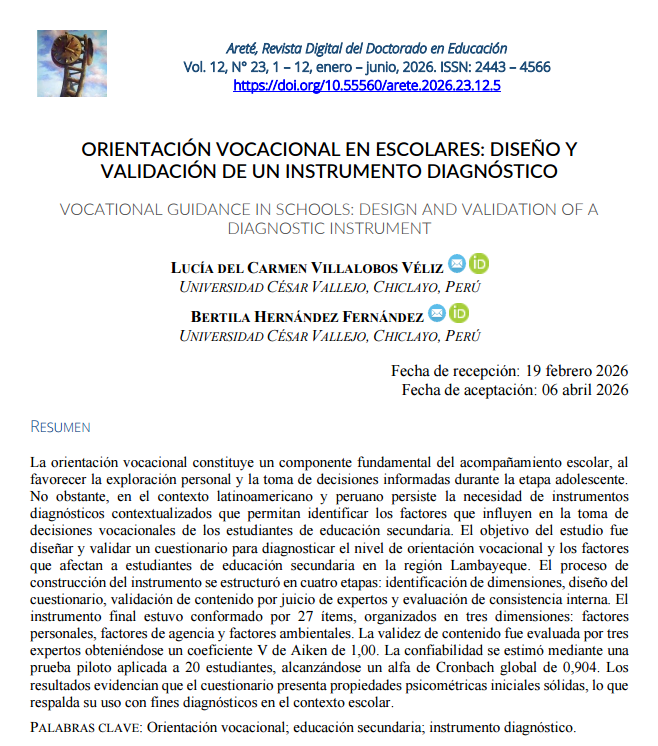
Vocational guidance in schools: design and validation of a diagnostic instrument
DOI:
https://doi.org/10.55560/arete.2026.23.12.5Keywords:
Vocational guidance, secondary education, diagnostic instrumentAbstract
Vocational guidance constitutes a fundamental component of school support, promoting personal exploration and informed decision-making during the adolescent stage. However, in the Latin American and Peruvian context, the need persists for contextualized diagnostic instruments that allow identifying the factors that influence the vocational decision-making of secondary education students. The objective of the study was to design and validate a questionnaire to diagnose the level of vocational orientation and the factors that affect secondary education students in the Lambayeque region. The instrument construction process was structured in four stages: identification of dimensions, questionnaire design, content validation by expert judgment and evaluation of internal consistency. The final instrument was made up of 27 items, organized into three dimensions: personal factors, agency factors and environmental factors. Content validity was evaluated by three experts, obtaining an Aiken V coefficient of 1.00. Reliability was estimated through a pilot test applied to 20 students, achieving a global Cronbach's alpha of 0.904. The results show that the questionnaire has solid initial psychometric properties, which support its use for diagnostic purposes in the school context.References
Abd, N., Izwan, M., & Ku, K. S. (2025). Conceptual Framework of A Career Module to Address Career Thinking Dysfunction, Enhance Career Maturity, and Career Adaptability among Pre-University Students. The Open Psychology Journal. https://doi.org/10.2174/0118743501422268251118104352
Anyango, E., Adama, E., Brown, J., & Ngune, I. (2024). An examination of the career decision-making self-efficacy of final-year nursing students. Nurse Education Today, 138, 106196. https://doi.org/10.1016/j.nedt.2024.106196
Baren, A. M., Taipe, F. R., Alba, O., & Mesa, P. (2025). Sistema de actividades educativas para la orientación vocacional hacia especialidades del bachillerato técnico. AlfaPublicaciones, 7(4), 77-105. https://doi.org/10.33262/ap.v7i4.653
Carrasco, E., & Valenzuela, D. (2021). Women who choose science: How self-efficacy, outcome expectations, barriers and support perceived influence the career choice. Calidad en la educación, (54), 271-302. https://doi.org/10.31619/caledu.n54.994
Condori, B. (2024). La orientación vocacional como factor clave en la permanencia de los estudiantes de educación básica superior en el bachillerato, con enfoque en la educación y formación técnica profesional. Star of Sciences Multidisciplinary Journal, 1(1), 1-12.
Crocetti, E., De Lise, F., Pagano, M., Bobba, B., Maratia, F., Meeus, W., & Bacaro, V. (2025). What’s Your Vocation? A Meta-Analysis of Interventions Tackling Youth Educational and Professional Identity. Identity, 25(2), 197-215. https://doi.org/10.1080/15283488.2024.2394861
Damodar, P., Shetty, A., Dsouza, M. P., Prakash, A., & Gudi, N. (2024). Crafting careers through theory-driven interventions: A scoping review of the utility of social cognitive career theory and career maturity inventory. International Journal of Adolescence and Youth, 29(1), 2308081. https://doi.org/10.1080/02673843.2024.2308081
Diao, R., & Yao, J. (2025). The effect of family support on college students’ slow employment intention: The chain mediating role of resilience and career choice effectiveness. Acta Psychologica, 254, 104810. https://doi.org/10.1016/j.actpsy.2025.104810
Dillon-Pérez, F., Rojas-Londoño, D., Lara-Ramos, E., & Freire-Muñoz, I. (2023). Orientación vocacional y profesional como alternativa en la elección de carreras universitarias. Revista Cátedra, 6(1), 78-91. https://doi.org/10.29166/catedra.v6i1.4109
Franco, E., & Polanco, M. (2023). Elección de la carrera profesional: Modelo predictivo en estudiantes de una universidad privada de Arequipa (Perú). Revista de Investigación en Psicología, 26(2), 5-31. https://doi.org/10.15381/rinvp.v26i2.25325
Jemini, L., Bërxulli, D., Konjufca, J., & Cakolli, L. (2023). Effectiveness of career guidance workshops on the career self-efficacy, outcome expectations, and career goals of adolescents: An intervention study. International Journal of Adolescence and Youth, 28(1), 2281421. https://doi.org/10.1080/02673843.2023.2281421
La Cruz, O. D., & Zelada, E. A. (2021). Orientación Vocacional y su relación con la elección de una carrera profesional en estudiantes. EPISTEME KOINONIA: Revista Electrónica de Ciencias de la Educación, Humanidades, Artes y Bellas Artes, 4(8), 549-559.
Leung, S. A., Mo, J., Yuen, M., & Cheung, R. (2022). Testing the career adaptability model with senior high school students in Hong Kong. Journal of Vocational Behavior, 139, 103808. https://doi.org/10.1016/j.jvb.2022.103808
Leung, S. A., & Zhou, S. (2025). Career Adaptability and Parental Career Support: A Moderated Mediation Model. Journal of Career Assessment, 33(4), 635-652. https://doi.org/10.1177/10690727241289945
Li, M., Zhang, S., & Zhang, L. (2024). Vocational college students’ vocational identity and self-esteem: Dynamics obtained from latent change score modeling. Personality and Individual Differences, 229, 112746. https://doi.org/10.1016/j.paid.2024.112746
Liao, X. (2024). An Equation Model for the Career Maturity and Learning Confidence of Students in Interdisciplinary Programs Integrated With Modern Technologies. International Journal of Web-Based Learning and Teaching Technologies, 19(1). https://doi.org/10.4018/IJWLTT.359360
Liu, X., Mei, X., & Ji, G. (2024). “Walking with Dreams”: The Categories of Career Decision-Making Self-Efficacy and Its Influence on Learning Engagement of Senior High School Students. Behavioral Sciences, 14(12), 1174. https://doi.org/10.3390/bs14121174
Mata-Correas, M., Hernández-Franco, V., & Prieto-Ursúa, M. (2025). Career indecision and career indecisiveness in high school and vocational training students: A scoping review. EDUXX1, 28(2), 257-303. https://doi.org/10.5944/educxx1.42209
Medina-Mina, T. A., & Parra-de la Paz, A. (2024). Vocational Training and Professional Orientation to promote the choice of technical careers at the «Leonidas Gruezo George» Educational Unit for the 2023-2024 period. Polo del Conocimiento, 9(3), 4163-4185.
Napolitano, C. M., Hoff, K. A., Ming, C. W. J., Tu, N., & Rounds, J. (2020). Great expectations: Adolescents’ intentional self-regulation predicts career aspiration and expectation consistency. Journal of Vocational Behavior, 120, 103423. https://doi.org/10.1016/j.jvb.2020.103423
Pham, M., Lam, B. Q., & Tuan Ngoc Bui, A. (2024). Career exploration and its influence on the relationship between self-efficacy and career choice: The moderating role of social support. Heliyon, 10(11), e31808. https://doi.org/10.1016/j.heliyon.2024.e31808
Resabala, L. L., Mendoza, A., Andrade, P. O., & Mendoza, P. A. (2024). Factores de la orientación vocacional que influyen en la elección del perfil profesional y la deserción universitaria del bachiller ecuatoriano. Revista Científica Arbitrada Multidisciplinaria PENTACIENCIAS, 6(7), 209-217. https://doi.org/10.59169/pentaciencias.v6i7.1328
Söner, O., & Gültekin, F. (2025). Middle school students’ career parental support and adolescent–parent career congruence: The mediating role of self-efficacy. International Journal for Educational and Vocational Guidance, 25(3), 981-1003. https://doi.org/10.1007/s10775-024-09658-7
Vargas-Hernández, E. Y., & Salas-Pérez, K. V. (2023). Retos y desafíos de las personas profesionales de la orientación vocacional: Una mirada desde los diversos contextos laborales en Costa Rica. Revista Costarricense de Orientación, 2(1), 1-20. https://doi.org/10.54413/rco.v2i1.32
Published
How to Cite
Issue
Section
License
Copyright (c) 2026 Lucía del Carmen Villalobos Véliz, Bertila Hernández Fernández

This work is licensed under a Creative Commons Attribution-NonCommercial-ShareAlike 4.0 International License.
This journal provides free, immediate access to its content under the principle of making research freely available to the public, which fosters a greater exchange of global knowledge.
Authors who publish in Areté, Revista Digital del Doctorado en Educación, agree to the following terms:
- Authors retain copyright and grant the journal the right to be the first publication of the work, as well as licensed under a Creative Commons Attribution License that allows others to share the work with an acknowledgement of authorship of the work and initial publication in this journal.
- Authors may separately establish additional agreements for the non-exclusive distribution of the version of the work published in the journal (for example, placing it in an institutional repository or publishing it in a book), with an acknowledgement of its initial publication in this journal and not to be used for commercial purposes.
- The contents and images included in the articles are the responsibility of the author(s). Areté, Revista Digital del Doctorado en Educación, is not responsible for the information included in them.
- Authors agree with the license of use used by the journal, with the self-archiving conditions and with the open access policy.
- Authors are allowed to disseminate electronically (e.g., in institutional repositories or on their own website) the published version of their work, as it favors its earlier circulation and dissemination and thus a possible increase in its citation and reach among the academic community.
- In case of reuse of published works, the existence and specifications of the license of use must be mentioned, as well as the authorship and original source of publication.