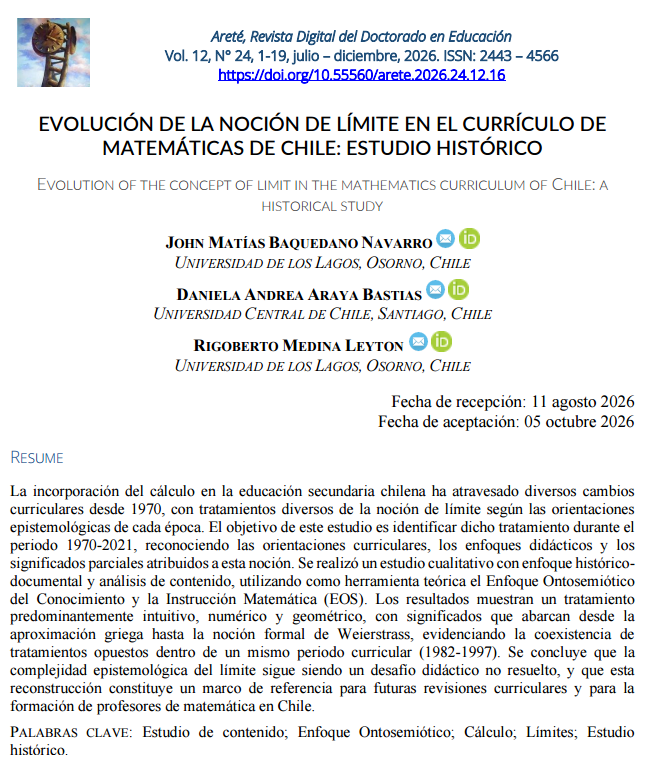
Evolution of the concept of limit in the mathematics curriculum of Chile: a historical study
DOI:
https://doi.org/10.55560/arete.2026.24.12.16Keywords:
Content Analysis, Onto-Semiotic Approach, Calculus, Limits, Historical studyAbstract
The incorporation of calculus into Chilean secondary education has undergone various curricular changes since 1970, with diverse treatments of the notion of limit according to the epistemological orientations of each era. The objective of this study is to identify such treatment during the period 1970-2021, recognizing the curricular orientations, didactic approaches, and partial meanings attributed to this notion. A qualitative study was conducted using a historical-documentary approach and content analysis, employing the Onto-Semiotic Approach to Mathematical Knowledge and Instruction (OSA) as a theoretical tool. The results show a predominantly intuitive, numerical, and geometric treatment, with meanings ranging from the Greek approximation to Weierstrass's formal notion, evidencing the coexistence of opposing treatments within the same curricular period (1982-1997). It is concluded that the epistemological complexity of the limit remains an unresolved didactic challenge, and that this reconstruction constitutes a reference framework for future curricular revisions and for the training of mathematics teachers in Chile.
References
Araya, D., Pino-Fan, L. R., Medrano, I. G., y Castro, W. F. (2021). Criterios epistémicos para el diseño de tareas sobre límite de una función en una variable real. Bolema, 35(69), 179-205. https://doi.org/10.1590/1980-4415v35n69a09
Araya, D. A., y Pino-Fan, L. R. (2023). Componentes e indicadores para el diseño y reflexión de procesos de instrucción sobre límites de funciones en una variable. Paradigma, 44(2), 409-426. https://doi.org/10.37618/PARADIGMA.1011-2251.2023.p409-426.id1392
Arnal-Palacián, M., y Claros-Mellado, J. (2022). Specialized Content Knowledge of pre-service teachers on the infinite limit of a sequence. Mathematics Teaching -Research Journal, 14(1), 169-189.
Arnal-Palacián, M., Claros-Mellado, J., y Oller-Marcén, A. M. (2024). La noción de límite en libros de texto españoles de segunda enseñanza del siglo XIX. Enseñanza de las Ciencias, 42(2), 197-219. https://doi.org/10.5565/rev/ensciencias.6111
Artigue, M. (1995). La enseñanza de los principios del cálculo: problemas epistemológicos, cognitivos y didácticos. En M. Artigue, R. Douady, L. Moreno, y P. Gómez (Eds.), Ingeniería didáctica en educación matemática (pp. 98-140). Grupo Editorial Iberoamericana.
Artigue, M. (1998). Enseñanza y aprendizaje del análisis elemental: ¿qué se puede aprender de las investigaciones didácticas y los cambios curriculares? Revista Latinoamericana de Investigación en Matemática Educativa, 1(1), 40-55.
Bamón, R., González, P., y Soto, J. (2002). 4° medio matemática activa. Mare Nostrum.
Bansilal, S., y Mkhwanazi, T. W. (2022). Pre-service student teachers' conceptions of the notion of limit. International Journal of Mathematical Education in Science and Technology, 53(8), 2083-2101.
Baquedano, J., Araya, D., y Medina, R. (2026). The landscape of knowledge models on the notion of limit in teachers: A systematic review. REDIMAT - Revista de Investigación en Didáctica de las Matemáticas, 15(2), 192-214. https://doi.org/10.17583/redimat.19086
Bardin, L. (1996). Análisis de contenido (2a ed.). Akal.
Blanco, S., De las Heras, R., Fuenzalida, G., y Riveros, J. A. (1994). Matemática educación media plan electivo. Santillana.
Blázquez, S., y Ortega, T. (2001). Los sistemas de representación en la enseñanza del límite. Revista Latinoamericana de Investigación en Matemática Educativa, 4(3), 219-236.
Bressoud, D., Ghedamsi, I., Martinez-Luaces, V., y Törner, G. (2016). Teaching and learning of calculus. Springer. https://doi.org/10.1007/978-3-319-32975-8
Bustos, C., y Ramos, E. (2022). Una mirada sobre conceptos del cálculo desde el conocimiento de los temas del profesorado de matemática de secundaria. Revista Innovaciones Educativas, 24(36), 84–100. https://doi.org/10.22458/ie.v24i36.3893
Carreño, X., y Cruz, X. (1984). Matemática cuarto medio. Arrayán.
Cory, B. L., y Garofalo, J. (2011). Using dynamic sketches to enhance preservice secondary Mathematics teachers' understanding of limits of sequences. Journal for Research in Mathematics Education, 42(1), 65-97. https://doi.org/10.5951/jresematheduc.42.1.0065
Elia, I., Gagatsis, A., Panaoura, A., Zachariades, T., y Zoulinaki, F. (2009). Geometry and algebraic approaches in the concept of “limit” and the impact of the “didactic contract”. International Journal of Science and Mathematics Education, 7, 765–790.
Espinoza, L., y Azcárate, C. (2000). Organizaciones matemáticas y didácticas en torno al objeto "límite de función": una propuesta metodológica para el análisis. Enseñanza de las Ciencias, 18(3), 355–368.
Fernández, C., Moreno, M., y Sánchez-Matamoros, G. (2024). Prospective secondary teachers' noticing of students' thinking about the limit concept: pathways of development. ZDM – Mathematics Education, 56, 1137-1151. https://doi.org/10.1007/s11858-024-01573-z
Fonseca, V., y Henriques, A. (2018). Compreensão da definição formal de limite: um estudo na formação inicial de professores de matemática. Bolema: Boletim de Educação Matemática, 32(62), 1030–1049. https://doi.org/10.1590/1980-4415v32n62a14
Fonseca, V. G. da, y Henriques, A. C. C. B. (2020). Learning with understanding the continuity concept: A teaching experiment with Brazilian pre-service mathematics teachers. International Electronic Journal of Mathematics Education, 15(3), em0606. https://doi.org/10.29333/iejme/8462
Font, V., y Godino, J. D. (2006). La noción de configuración epistémica como herramienta de análisis de textos matemáticos: su uso en la formación de profesores. Educación Matemática y Pesquisa, 8(1), 67-98.
Godino, J. D. (2023). Enfoque Ontosemiótico de la filosofía de la matemática educativa. Paradigma, 44(2), 7-33.
Godino, J. D. (2024). Enfoque Ontosemiótico en educación matemática: fundamentos, herramientas y aplicaciones. Editorial Aula Magna - McGraw-Hill.
Godino, J. D., y Batanero, C. (1994). Significado institucional y personal de los objetos matemáticos. Recherches en Didactique des Mathématiques, 14(3), 325-355.
González, Y., Montoro, A. B., y Ruiz, J. F. (2024). Significado del límite expresado por estudiantes universitarios. Educación Matemática, 36(3), 242-271. https://doi.org/10.24844/EM3603.09
Gutiérrez, C., y Gutiérrez, F. (2014). Ricardo Poenisch: La profesionalización de la enseñanza de las matemáticas en Chile (1889-1930). Atenea, 509, 187-209.
Hitt, F. (2003). Dificultades de aprendizaje del concepto de límite y actividades de enseñanza. Revista Latinoamericana de Investigación en Matemática Educativa, 6(2), 133-157.
Kula, S., y Bukova, E. (2019). Prospective mathematics teachers' choice and use of representations in teaching limit concept. International Journal of Research in Education and Science (IJRES), 5(1), 134-156.
Landis, J. R., y Koch, G. G. (1977). The measurement of observer agreement for categorical data. Biometrics, 33(1), 159-174. https://doi.org/10.2307/2529310
León, O. G., y Montero, I. (2020). Métodos de investigación en psicología y educación: las tradiciones cuantitativa y cualitativa (4a ed.). McGraw-Hill.
Medrano, I., y Pino-Fan, L. R. (2016). Estadios de comprensión de la noción matemática de límite finito desde el punto de vista histórico. REDIMAT, 5(3), 287-323. https://doi.org/10.4471/redimat.2016.1874
Mena-Lorca, A., Mena-Lorca, J., Montoya-Delgadillo, E., Morales, A., y Parraguez, M. (2015). The epistemological obstacle of the actual infinity: Persistence, resistence and categories of analysis. Revista Latinoamericana de Investigación en Matemática Educativa, 18(3), 329-358. https://doi.org/10.12802/relime.13.1832
Mercado, C. (1974). Curso de matemáticas elementales II. Universitaria.
Ministerio de Educación de Chile. (1970). Programas de educación media. Revista de Educación, (31).
Ministerio de Educación de Chile. (1974). Programas de educación media. Revista de Educación, (52-54).
Ministerio de Educación de Chile. (1982). Planes y programas de estudio para la educación media. Revista de Educación, (94), 171-173.
Ministerio de Educación de Chile. (1998). Matemática: funciones y procesos infinitos. CPEIP.
Ministerio de Educación de Chile. (2015). Programa de estudio: actualización 2009, cuarto año medio.
Ministerio de Educación de Chile. (2021). Programa de estudio 3° o 4° medio: formación diferenciada matemática: límites, derivadas e integrales. Unidad de Currículum y Evaluación.
Parameswaran, R. (2007). On understanding the notion of limits and infinitesimal quantities. International Journal of Science and Mathematics Education, 5, 193–216.
Picado, M. (2011). Análisis de contenido en textos históricos de matemáticas. PNA. Revista de Investigación en Didáctica de la Matemática, 6(1), 1-14.
Quecedo, R., y Castaño, C. (2002). Introducción a la metodología de investigación cualitativa. Revista de Psicodidáctica, (14), 5-39. https://www.redalyc.org/articulo.oa?id=17501402
Rodríguez, F. M., Basso, A., y García, M. S. (2019). El análisis de textos como metodología de investigación en educación matemática. En Actas de la XV Conferencia Interamericana de Educación Matemática (CIAEM-IACME). Medellín, Colombia.
Savuran, R., e Isiksal-Bostan, M. (2022). Revealing implicit knowledge of pre-service mathematics teachers in lesson planning: Knowledge of infinity. European Journal of Science and Mathematics Education, 10(3), 269-283. https://doi.org/10.30935/scimath/11838
Sierpińska, A. (1985). Obstacles épistémologiques relatifs à la notion de limite. Recherches en Didactique des Mathématiques, 6(1), 5-67.
Sierra Vázquez, M., González Astudillo, M. T., y López Esteban, C. (1999). Evolución histórica del concepto de límite funcional en los libros de texto de bachillerato y Curso de Orientación Universitaria (COU): 1940-1995. Enseñanza de las Ciencias, 17(3), 463-476.
Soto, F. (2010). Historia de la educación chilena. CPEIP.
Soto, J., y González, P. (2003). Matemática texto para el estudiante 4° medio. Mare Nostrum.
Soto, J., y González, P. (2005). Matemática 4° medio. Mare Nostrum.
Tuna, A., Biber, A. C., y Korkmaz, S. (2019). What do teacher candidates know about the limits of the sequences? Journal of Curriculum and Teaching, 8(3), 132-142. https://doi.org/10.5430/jct.v8n3p132
Yıldız, B., e İnceoğlu, G. (2020). Mathematics teacher candidates’ conceptual knowledge of the concept of limit in single-variable functions. Turkish Online Journal of Qualitative Inquiry, 11(4), 511–532. https://doi.org/10.17569/tojqi.748187
Published
How to Cite
Issue
Section
License
Copyright (c) 2026 John Matías Baquedano Navarro, Daniela Andrea Araya Bastias, Rigoberto Medina Leyton

This work is licensed under a Creative Commons Attribution-NonCommercial-NoDerivatives 4.0 International License.
This journal provides free, immediate access to its content under the principle of making research freely available to the public, which fosters a greater exchange of global knowledge.
Authors who publish in Areté, Revista Digital del Doctorado en Educación, agree to the following terms:
- Authors retain copyright and grant the journal the right to be the first publication of the work, as well as licensed under a Creative Commons Attribution License that allows others to share the work with an acknowledgement of authorship of the work and initial publication in this journal.
- Authors may separately establish additional agreements for the non-exclusive distribution of the version of the work published in the journal (for example, placing it in an institutional repository or publishing it in a book), with an acknowledgement of its initial publication in this journal and not to be used for commercial purposes.
- The contents and images included in the articles are the responsibility of the author(s). Areté, Revista Digital del Doctorado en Educación, is not responsible for the information included in them.
- Authors agree with the license of use used by the journal, with the self-archiving conditions and with the open access policy.
- Authors are allowed to disseminate electronically (e.g., in institutional repositories or on their own website) the published version of their work, as it favors its earlier circulation and dissemination and thus a possible increase in its citation and reach among the academic community.
- In case of reuse of published works, the existence and specifications of the license of use must be mentioned, as well as the authorship and original source of publication.