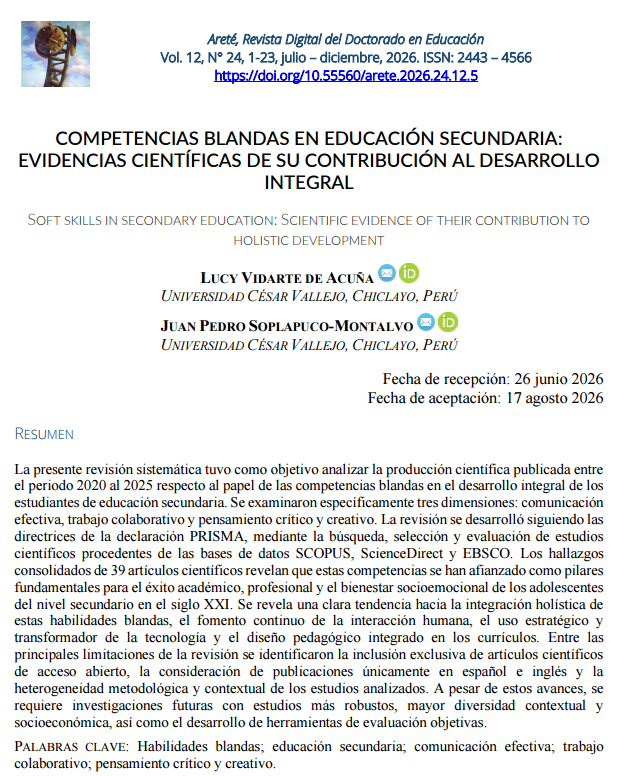
Soft skills in secondary education: Scientific evidence of their contribution to holistic development
DOI:
https://doi.org/10.55560/arete.2026.24.12.5Keywords:
Soft skills, secondary education, effective communication, collaborative work, critical and creative thinkingAbstract
This systematic review aimed to analyze scientific literature published between 2020 and 2025 regarding the role of soft skills in the holistic development of secondary education students. Specifically, three dimensions were examined: effective communication, collaborative work, and critical and creative thinking. The review was conducted in accordance with PRISMA guidelines, involving the search, selection, and evaluation of scientific studies from the SCOPUS, ScienceDirect, and EBSCO databases. Consolidated findings from 39 scientific articles reveal that these competencies have established themselves as fundamental pillars for the academic and professional success, as well as the socio-emotional well-being, of secondary-level adolescents in the 21st century. A clear trend emerges toward the holistic integration of these soft skills, the continuous fostering of human interaction, the strategic and transformative use of technology, and pedagogical designs integrated into curricula. Key limitations identified in the review include the exclusive inclusion of open-access scientific articles, the restriction to publications in Spanish and English, and the methodological and contextual heterogeneity of the analyzed studies. Despite these advances, future research is needed—specifically studies that are more robust, encompass greater contextual and socioeconomic diversity, and involve the development of objective assessment tools.
References
Abbasi, B. N., & Luo, Z. (2025). Evaluating the impact of structural and policy-driven school factors on the development of non-cognitive abilities among Chinese children. Children and Youth Services Review, 169, 108095. https://doi.org/10.1016/j.childyouth.2024.108095
Abid, N., Samuel, A., Ali, R., Shoaib, A., & Warraich, W. Y. (2022). Students’ interpersonal skills and its association with their academic achievement in secondary school of Pakistan. International Journal of Evaluation and Research in Education (IJERE), 11(1), Article 1. https://doi.org/10.11591/ijere.v11i1.21798
Akdim, M., Alami, A., Selmaoui, S., Sabiri, A., & Akdim, H. (2022). The Field Skills’ Development through Teaching Environmental Interactions in High School: Draa-Tafilalet Region, Morocco. Education Sciences, 12(11), Article 11. https://doi.org/10.3390/educsci12110772
Akyıldız, S. T., & Çelik, V. (2020). Thinking outside the box: Turkish EFL teachers’ perceptions of creativity. Thinking Skills and Creativity, 36, 100649. https://doi.org/10.1016/j.tsc.2020.100649
Alsuwaidi, L., Otaki, F., Khamis, A. H., AlGurg, R., & Lakhtakia, R. (2023). Selected Skill Sets as Building Blocks for High School-to-Medical School Bridge: Longitudinal Study Among Undergraduate Medical Students. JMIR Medical Education, 9(1), e43231. https://doi.org/10.2196/43231
Annus, I., & Kaur, K. (2025). ChangeMakers – Promoting Engineering Through Developing the Soft Skills of Youngsters. Lecture Notes in Networks and Systems, 1280, 184-194. https://doi.org/10.1007/978-3-031-83523-0_17
Bećirović, S., Dubravac, V., & Brdarević-Čeljo, A. (2022). Cooperative Learning as a Pathway to Strengthening Motivation and Improving Achievement in an EFL Classroom. Sage Open, 12(1). https://doi.org/10.1177/21582440221078016
Castillo, L., & Saavedra, R. (2024). A Comparative Analysis between Artificial Intelligence and Traditional Learning Methods in Developing Critical Thinking Skills among Secondary Education Students in Peru. Proceedings of the World Multi-Conference on Systemics, Cybernetics and Informatics, 200-202. https://doi.org/10.54808/wmsci2024.01.200
Chaiban, T., & Oweini, A. (2024). Assessing post-Covid-19 Lebanese teachers’ attitudes towards ICT and their level of integration in the classroom in relation to their years of experience. Heliyon, 10(18), https://doi.org/10.1016/j.heliyon.2024.e38266
Chessa, M., Delzanno, G., Ferrando, A., Gelati, L., Guerrini, G., Mascardi, V., Noceti, N., Odone, F., & Vitali, F. (2022). Smart rogaining for computer science orientation. Frontiers in Education, 7. https://doi.org/10.3389/feduc.2022.971027
Conceição, C., Cadima, J., Camacho, A., & Alves, D. (2025). Testing the Effectiveness of a Social and Emotional Skill Program for Preschool Children. Early Childhood Education Journal, 1-15. https://doi.org/10.1007/s10643-025-01909-8
Dizdarević, D., Leskovar, R., & Vukovič, G. (2024). Primus inter pares effect in high schools. Frontiers in Psychology, 15. https://doi.org/10.3389/fpsyg.2024.1382062
Double, K. S., Masri, Y. E., McGrane, J. A., & Hopfenbeck, T. N. (2023). Do IB students have higher critical thinking? A comparison of IB with national education programs. Thinking Skills and Creativity, 50, 101416. https://doi.org/10.1016/j.tsc.2023.101416
Du, X., & Liu, Z. (2022). Influence of physical education on the mental health of college students. Revista Brasileira de Medicina Do Esporte, 28, 311-314. https://doi.org/10.1590/1517-8692202228042021_0062
ERIC Thesaurus. (2022). ERIC - Education Resources Information Center. https://eric.ed.gov/
Fernandez-Rio, J., & Casey, A. (2021). Sport education as a cooperative learning endeavour. Physical Education and Sport Pedagogy, 26(4), 375-387. https://doi.org/10.1080/17408989.2020.1810220
Fernandez-Rio, J., Cecchini, J. A., Morgan, K., Mendez-Gimenez, A., & Lloyd, R. (2022). Validation of the Cooperative Learning Scale and Cooperation Global Factor Using Bifactor Structural Equation Modelling. Educational Psychology, 28(2), 91-97. https://doi.org/10.5093/psed2021a2
Giordano, F., Calaresi, D., Saladino, V., & Verrastro, V. (2025). Perception of Loneliness in Adolescence: Role of Maladaptive Personality Traits and Trauma-Related Symptomatology. Brain Sciences, 15(1), https://doi.org/10.3390/brainsci15010086
Gonzáles, C. M., García, M., Gonzáles, S. A., Canché, M., Solís, N. V., & Guadalupe, M. (2025). Pensamiento Computacional mixto con robótica y reciclaje en un proyecto social. Revista EIA, 22(43), 1-27. https://doi.org/10.24050/reia.v22i43.1827
Gutiérrez Ulloa, C. R., Cordova Castillo, C. W., Acosta Enriquez, B. G., Villena Zapata, L., García Salirrosas, L. M., Vilcapoma Pérez, C. R., & López Roca, C. (2023). Predeco program and its effectiveness on interpersonal relationships in high school students. Igniting the Spark of Innovation: Emerging Trends, Disruptive Technologies, and Innovative Models for Business Success. https://laccei.org/LEIRD2023-VirtualEdition/meta/fp101.html
Huttunen, I., Upadyaya, K., & Salmela-Aro, K. (2024). Longitudinal associations between adolescents’ social-emotional skills, school engagement, and school burnout. Learning and Individual Differences, 115, 102537. https://doi.org/10.1016/j.lindif.2024.102537
Johnson, K. L. (2020). US Pilot Curriculum for Transitioning Students with Autism Spectrum Disorders from High School to College and the Workforce. Folia Phoniatrica et Logopaedica, 73(3), 241-247. https://doi.org/10.1159/000509836
Kaewkamol, P., Thanyaphongphat, J., & Noamna, S. (2025). Promoting 21st Century Skills in Programming Education through Collaborative and Problem-Based Learning in Smart Farming. Joint International Conference on Digital Arts, Media and Technology with ECTI Northern Section Conference on Electrical, Electronics, Computer and Telecommunications Engineering (ECTI DAMT & NCON), Nan, Thailand, pp. 59-63 https://doi.org/10.1109/ECTIDAMTNCON64748.2025.10962023
Kain, C., Koschmieder, C., Matischek-Jauk, M., & Bergner, S. (2024). Mapping the landscape: A scoping review of 21st century skills literature in secondary education. Teaching and Teacher Education, 151, 104739. https://doi.org/10.1016/j.tate.2024.104739
Khlaisang, J., Huang, F., Koraneekij, P., & Teo, T. (2023). Using mobile technologies to teach 21st century learning skills: A study of teachers’ acceptance in Thai secondary schools. International Journal of Mobile Learning and Organisation, 17(1-2), 254-279. https://doi.org/10.1504/ijmlo.2023.128343
Kurata, L., Ayanwale, M. A., Molefi, R. R., & Sanni, T. (2025). Teaching religious studies with artificial intelligence: A qualitative analysis of Lesotho secondary schools teachers’ perceptions. International Journal of Educational Research Open, 8, 100417. https://doi.org/10.1016/j.ijedro.2024.100417
Lazou, C., & Tsinakos, A. (2025). A Framework for Participatory Creation of Digital Futures: A Longitudinal Study on Enhancing Media Literacy and Inclusion in K-12 Through Virtual Reality. Information, 16(6), Article 6. https://doi.org/10.3390/info16060482
Liang, C., Majumdar, R., Nakamizo, Y., Flanagan, B., & Ogata, H. (2024). Algorithmic group formation and group work evaluation in a learning analytics-enhanced environment: Implementation study in a Japanese junior high school. Interactive Learning Environments, 32(4), 1476-1499. https://doi.org/10.1080/10494820.2022.2121730
Liu, Z., Guo, J., Huang, H., & Tang, X. (2025). Which social-emotional skills are most important for students’ learning and well-being? An international comparison among China, USA and Finland. Learning and Individual Differences, 121, 102703. https://doi.org/10.1016/j.lindif.2025.102703
Llanos-Ruiz, D., Ausin-Villaverde, V., & Abella-Garcia, V. (2024). Interpersonal and Intrapersonal Skills for Sustainability in the Educational Robotics Classroom. Sustainability, 16(11), Article 11. https://doi.org/10.3390/su16114503
Marcillo, D. G. B., Acurio, J. A. B., & García, J. C. L. (2024). Influencia de las herramientas digitales como recursos didácticos en la figura profesional de electromecánica en el Ecuador. Tesla Revista Científica, 4(2), Article 2. https://doi.org/10.55204/trc.v4i2.e408
Marín, J.-A., García, P. A., & Duo, P. (2024). Computational thinking and programming with Arduino in education: A systematic review for secondary education. Heliyon, 10(8), e29177. https://doi.org/10.1016/j.heliyon.2024.e29177
Nahar, L., & Machado, C. (2025). Inquiry-based learning in Bangladesh: Insights into middle and high school students’ experiences and 21st century skill development. Disciplinary and Interdisciplinary Science Education Research, 7(1). https://doi.org/10.1186/s43031-025-00122-2
Neelakantan, L., Logan, N., Raniti, M., & Reavley, N. (2025). Impacts of adolescent participation in a mental health education, leadership, and advocacy program (the Live4Life Crew) on outcomes after leaving secondary school in Victoria, Australia: A qualitative study. SSM - Mental Health, 7, 1-12, https://doi.org/10.1016/j.ssmmh.2025.100448
OECD. (2022). Habilidades para el progreso social: El poder de las habilidades sociales y emocionales. https://www.oecd.org/es/publications/habilidades-para-el-progreso-social_9789264253292-es.html
Oh, S. (2025). Arduino-based fine particulate matter STEM program: Enhancing problem-solving and collaboration in a post-pandemic blended high school setting. Frontiers in Psychology, 16. https://doi.org/10.3389/fpsyg.2025.1524777
O’Reilly, C., Devitt, A., & Hayes, N. (2022). Critical thinking in the preschool classroom—A systematic literature review. Thinking Skills and Creativity, 46, 101110. https://doi.org/10.1016/j.tsc.2022.101110
Palacios, S. S. S., & Salas-Blas, E. (2020). Resiliencia y habilidades sociales en estudiantes secundarios de San Luis de Shuaro, La Merced. Comuni@cción: Revista de Investigación en Comunicación y Desarrollo, 11(1), Article 1. https://doi.org/10.33595/2226-1478.11.1.394
Pellegrino, G., Feraco, T., Meneghetti, C., & Carretti, B. (2025). Ready for What’s Next? The Associations Between Social, Emotional, and Behavioral Skills and Career Adaptability in High School Students. Journal of Adolescence, 97, 1200-1210. https://doi.org/10.1002/jad.12486
Phuti, F., Koloi-Keaikitse, S., Tsheko, G. N., & Oppong, S. (2023). Developing and Validating a Soft Skills Assessment Scale for Psychoeducational Assessment. Sage Open, 13(4), 21582440231218066. https://doi.org/10.1177/21582440231218066
PRISMA. (2024). PRISMA statement. PRISMA Statement. https://www.prisma-statement.org
Qian, X., Johnson, D., & Papay, C. (2021). Exploring Correlates of Paid Early Work Experiences for Youth With Autism Using NLTS2012 Data. Focus on Autism and Other Developmental Disabilities, 36(1), 14-24. https://doi.org/10.1177/1088357620956915
Rahmawati, Y., Ridwan, A., Heriyanti, Amalia, R., & Agustin, M. A. (2021). Dilemma teaching pedagogy for students’ soft skills development in chemistry using dilemma stories learning of polymer topic. AIP Conference Proceedings, 2331(1), 040044. https://doi.org/10.1063/5.0041919
Ratmono, B. M., Kurniasih, D., & Setyoko, P. I. (2023). Exploring the effects of social media and cyberbullying on senior high schools student interpersonal communication. Journal of Law and Sustainable Development, 11(2). https://doi.org/10.55908/sdgs.v11i2.411
Rehman, N., Huang, X., Mahmood, A., AlGerafi, M. A. M., & Javed, S. (2024). Project-based learning as a catalyst for 21st-Century skills and student engagement in the math classroom. Heliyon, 10(23), https://doi.org/10.1016/j.heliyon.2024.e39988
Roshid, M. M., & Haider, Md. Z. (2024). Teaching 21st-century skills in rural secondary schools: From theory to practice. Heliyon, 10(9), https://doi.org/10.1016/j.heliyon.2024.e30769
Sari, M. N., Harto, S. P., & Muhyadi, M. (2024). Development of entrepreneurship education based on the menara berkah model in Indonesian vocational high schools. Journal of Education and Learning (EduLearn), 18(3), Article 3. https://doi.org/10.11591/edulearn.v18i3.21003
Sary, M. P., Bajari, A., Sugiana, D., & Sjafirah, N. A. (2024). Homeschool internship program for students’ interpersonal communication development: A descriptive study. International Journal of Innovative Research and Scientific Studies, 7(2), 618-626. https://doi.org/10.53894/ijirss.v7i2.2704
Segarra, M. S., & Esparza, C. A. (2023). Self-perception of leadership and communication: A comparative study between female high school and university students in Ecuador. https://laccei.org/LEIRD2024-VirtualEdition/meta/FP565.html
Shafiq, A., Naseem, D. A., & Fatima, D. S. G. (2025). Integrating social skills and learning: the role of socio-emotional intelligence in student collaboration. Journal of Applied Linguistics and TESOL (JALT), 8(1), Article 1.
Silitonga, L. L., Maruli, S., & Simanjuntak, H. (2025). The impact of well-being on self-confidence: The mediating role of soft skills among adolescents. Cognitive Development, 74, 101567. https://doi.org/10.1016/j.cogdev.2025.101567
Sirinterlikci, A., Al-Jaroodi, J., & Moretti, A. (2024). Integrating Soft Skills into Technical Curriculum. ASEE Annual Conference and Exposition, Conference Proceedings.
Song, H., & Cai, L. (2024). Interactive learning environment as a source of critical thinking skills for college students. BMC Medical Education, 24(1). https://doi.org/10.1186/s12909-024-05247-y
Soto, C. J., Napolitano, C. M., Sewell, M. N., Yoon, H. J., & Roberts, B. W. (2024). Going Beyond Traits: Social, Emotional, and Behavioral Skills Matter for Adolescents’ Success. Social Psychological and Personality Science, 15(1), 33-45. https://doi.org/10.1177/19485506221127483
Sousa, M., Sousa, C., & Luz, F. (2023). The Novelty of Collaboration: High School Students Learning and Enjoyment Perceptions When Playing Cooperative Modern Board Games. European Conference on Games Based Learning, 17(1), 632-642 https://doi.org/10.34190/ecgbl.17.1.1461
Suherman, S., & Vidákovich, T. (2024). Role of creative self-efficacy and perceived creativity as predictors of mathematical creative thinking: Mediating role of computational thinking. Thinking Skills and Creativity, 53, 101591. https://doi.org/10.1016/j.tsc.2024.101591
Sun, M., Wang, M., Wegerif, R., & Peng, J. (2022). How do students generate ideas together in scientific creativity tasks through computer-based mind mapping? Computers & Education, 176, 104359. https://doi.org/10.1016/j.compedu.2021.104359
Susilawati, Aznam, N., Paidi, & Ngadimin. (2020). Teachers’ perspectives toward soft skills in science learning. Journal of Physics: Conference Series, 1460(1), 012111. https://doi.org/10.1088/1742-6596/1460/1/012111
Synytsia, A., Koval, I., Kuzhelnyi, S., Dzhemesiuk, S., Kudin, S., Kuzhelnyi, A., Zhlobo, T., & Zhula, L. (2025). The role of physical education in shaping soft skills and self-regulation in senior students: An economic perspective. SPORT TK-EuroAmerican Journal of Sport Sciences, 14, 6-6. https://doi.org/10.6018/sportk.644821
Tanjung, D., Syahwani, A. K. I., Ayuningtyas, G., Sholihah, W., & Rivtryana, D. A. (2025). Evaluating the impact of the teaching factory model on Vocational High School student competencies in the SMK Centre of excellence program. BIO Web Conf. 171. https://doi.org/10.1051/bioconf/202517104015
Tumbaco, G. P., Rivera, J. A., & Macías, T. M. (2025). Habilidades de comunicación en estudiantes de educación. https://ve.scielo.org/scielo.php?pid=S2739-00632025000202012&script=sci_arttext&utm_source=chatgpt.com
UNESCO. (2022). UNESCO Thesaurus. https://vocabularies.unesco.org/browser/thesaurus/en/
UNESCO. (2024). Informe sobre las habilidades socioemocionales en salas de clases de América Latina y el Caribe. https://www.unesco.org/es/articles/la-unesco-publica-un-informe-sobre-las-habilidades-socioemocionales-en-salas-de-clases-de-america
Widad, A., & Abdellah, G. (2022). Strategies Used to Teach Soft Skills in Undergraduate Nursing Education: A Scoping Review. Journal of Professional Nursing, 42, 209-218. https://doi.org/10.1016/j.profnurs.2022.07.010
Widyastuti, D. A., Purwanta, E., Astuti, B., Izzaty, R. E., Farozin, M., Ismail, A., & Naini, R. (2025). Assessing Validity and Reliability of Muslim Student’ Interpersonal Communication Scale: A Rasch Model Study. Islamic Guidance and Counseling Journal, 8(1). https://doi.org/10.25217/0020258551200
Yehya, A., Rajoh, O. A., & Qadhi, S. M. (2024). A Retrospective Analysis of Interactive Videos and Skill Development in First-Year Seminars at a Higher Education Institution. International Journal of Learning, Teaching and Educational Research, 23(11). https://www.ijlter.org/index.php/ijlter/article/view/11594
Zambrano, D. de la P., & Rodríguez-Pichardo, C. (2023). Experiencia socioformativa empleando Recursos Educativos Abiertos como apoyo al aprendizaje cooperativo en tiempo pospandemia. Entreciencias: Diálogos en la Sociedad del Conocimiento, 11(25), https://doi.org/10.22201/enesl.20078064e.2023.25.83990
Published
How to Cite
Issue
Section
License
Copyright (c) 2026 Lucy Vidarte de Acuña, Juan Pedro Soplapuco-Montalvo

This work is licensed under a Creative Commons Attribution-NonCommercial-NoDerivatives 4.0 International License.
This journal provides free, immediate access to its content under the principle of making research freely available to the public, which fosters a greater exchange of global knowledge.
Authors who publish in Areté, Revista Digital del Doctorado en Educación, agree to the following terms:
- Authors retain copyright and grant the journal the right to be the first publication of the work, as well as licensed under a Creative Commons Attribution License that allows others to share the work with an acknowledgement of authorship of the work and initial publication in this journal.
- Authors may separately establish additional agreements for the non-exclusive distribution of the version of the work published in the journal (for example, placing it in an institutional repository or publishing it in a book), with an acknowledgement of its initial publication in this journal and not to be used for commercial purposes.
- The contents and images included in the articles are the responsibility of the author(s). Areté, Revista Digital del Doctorado en Educación, is not responsible for the information included in them.
- Authors agree with the license of use used by the journal, with the self-archiving conditions and with the open access policy.
- Authors are allowed to disseminate electronically (e.g., in institutional repositories or on their own website) the published version of their work, as it favors its earlier circulation and dissemination and thus a possible increase in its citation and reach among the academic community.
- In case of reuse of published works, the existence and specifications of the license of use must be mentioned, as well as the authorship and original source of publication.