Competencias blandas en educación secundaria: Evidencias científicas de su contribución al desarrollo integral
DOI:
https://doi.org/10.55560/arete.2026.24.12.5Palabras clave:
Habilidades blandas, educación secundaria, comunicación efectiva, trabajo colaborativo, pensamiento crítico y creativoResumen
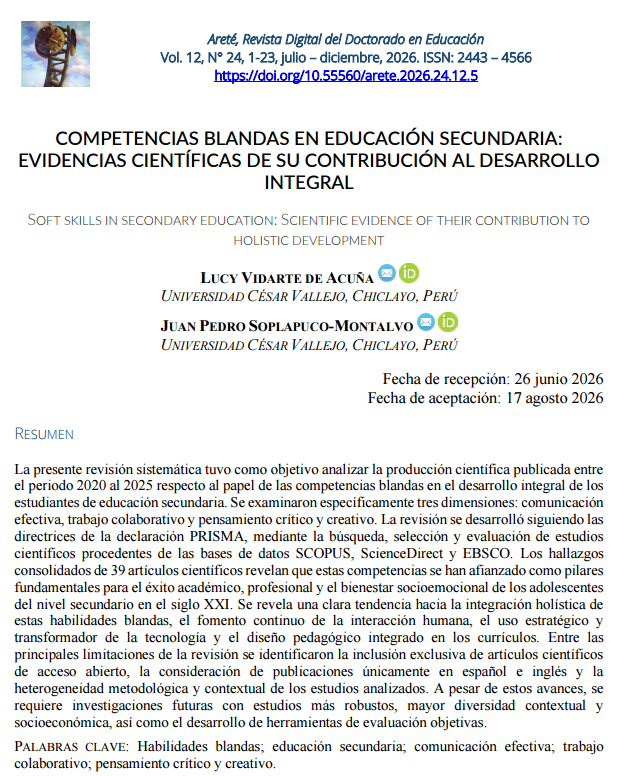
La presente revisión sistemática tuvo como objetivo analizar la producción científica publicada entre el periodo 2020 al 2025 respecto al papel de las competencias blandas en el desarrollo integral de los estudiantes de educación secundaria. Se examinaron específicamente tres dimensiones: comunicación efectiva, trabajo colaborativo y pensamiento crítico y creativo. La revisión se desarrolló siguiendo las directrices de la declaración PRISMA, mediante la búsqueda, selección y evaluación de estudios científicos procedentes de las bases de datos SCOPUS, ScienceDirect y EBSCO. Los hallazgos consolidados de 39 artículos científicos revelan que estas competencias se han afianzado como pilares fundamentales para el éxito académico, profesional y el bienestar socioemocional de los adolescentes del nivel secundario en el siglo XXI. Se revela una clara tendencia hacia la integración holística de estas habilidades blandas, el fomento continuo de la interacción humana, el uso estratégico y transformador de la tecnología y el diseño pedagógico integrado en los currículos. Entre las principales limitaciones de la revisión se identificaron la inclusión exclusiva de artículos científicos de acceso abierto, la consideración de publicaciones únicamente en español e inglés y la heterogeneidad metodológica y contextual de los estudios analizados. A pesar de estos avances, se requieren investigaciones futuras con estudios más robustos, mayor diversidad contextual y socioeconómica, así como el desarrollo de herramientas de evaluación objetivas.
Citas
Abbasi, B. N., & Luo, Z. (2025). Evaluating the impact of structural and policy-driven school factors on the development of non-cognitive abilities among Chinese children. Children and Youth Services Review, 169, 108095. https://doi.org/10.1016/j.childyouth.2024.108095
Abid, N., Samuel, A., Ali, R., Shoaib, A., & Warraich, W. Y. (2022). Students’ interpersonal skills and its association with their academic achievement in secondary school of Pakistan. International Journal of Evaluation and Research in Education (IJERE), 11(1), Article 1. https://doi.org/10.11591/ijere.v11i1.21798
Akdim, M., Alami, A., Selmaoui, S., Sabiri, A., & Akdim, H. (2022). The Field Skills’ Development through Teaching Environmental Interactions in High School: Draa-Tafilalet Region, Morocco. Education Sciences, 12(11), Article 11. https://doi.org/10.3390/educsci12110772
Akyıldız, S. T., & Çelik, V. (2020). Thinking outside the box: Turkish EFL teachers’ perceptions of creativity. Thinking Skills and Creativity, 36, 100649. https://doi.org/10.1016/j.tsc.2020.100649
Alsuwaidi, L., Otaki, F., Khamis, A. H., AlGurg, R., & Lakhtakia, R. (2023). Selected Skill Sets as Building Blocks for High School-to-Medical School Bridge: Longitudinal Study Among Undergraduate Medical Students. JMIR Medical Education, 9(1), e43231. https://doi.org/10.2196/43231
Annus, I., & Kaur, K. (2025). ChangeMakers – Promoting Engineering Through Developing the Soft Skills of Youngsters. Lecture Notes in Networks and Systems, 1280, 184-194. https://doi.org/10.1007/978-3-031-83523-0_17
Bećirović, S., Dubravac, V., & Brdarević-Čeljo, A. (2022). Cooperative Learning as a Pathway to Strengthening Motivation and Improving Achievement in an EFL Classroom. Sage Open, 12(1). https://doi.org/10.1177/21582440221078016
Castillo, L., & Saavedra, R. (2024). A Comparative Analysis between Artificial Intelligence and Traditional Learning Methods in Developing Critical Thinking Skills among Secondary Education Students in Peru. Proceedings of the World Multi-Conference on Systemics, Cybernetics and Informatics, 200-202. https://doi.org/10.54808/wmsci2024.01.200
Chaiban, T., & Oweini, A. (2024). Assessing post-Covid-19 Lebanese teachers’ attitudes towards ICT and their level of integration in the classroom in relation to their years of experience. Heliyon, 10(18), https://doi.org/10.1016/j.heliyon.2024.e38266
Chessa, M., Delzanno, G., Ferrando, A., Gelati, L., Guerrini, G., Mascardi, V., Noceti, N., Odone, F., & Vitali, F. (2022). Smart rogaining for computer science orientation. Frontiers in Education, 7. https://doi.org/10.3389/feduc.2022.971027
Conceição, C., Cadima, J., Camacho, A., & Alves, D. (2025). Testing the Effectiveness of a Social and Emotional Skill Program for Preschool Children. Early Childhood Education Journal, 1-15. https://doi.org/10.1007/s10643-025-01909-8
Dizdarević, D., Leskovar, R., & Vukovič, G. (2024). Primus inter pares effect in high schools. Frontiers in Psychology, 15. https://doi.org/10.3389/fpsyg.2024.1382062
Double, K. S., Masri, Y. E., McGrane, J. A., & Hopfenbeck, T. N. (2023). Do IB students have higher critical thinking? A comparison of IB with national education programs. Thinking Skills and Creativity, 50, 101416. https://doi.org/10.1016/j.tsc.2023.101416
Du, X., & Liu, Z. (2022). Influence of physical education on the mental health of college students. Revista Brasileira de Medicina Do Esporte, 28, 311-314. https://doi.org/10.1590/1517-8692202228042021_0062
ERIC Thesaurus. (2022). ERIC - Education Resources Information Center. https://eric.ed.gov/
Fernandez-Rio, J., & Casey, A. (2021). Sport education as a cooperative learning endeavour. Physical Education and Sport Pedagogy, 26(4), 375-387. https://doi.org/10.1080/17408989.2020.1810220
Fernandez-Rio, J., Cecchini, J. A., Morgan, K., Mendez-Gimenez, A., & Lloyd, R. (2022). Validation of the Cooperative Learning Scale and Cooperation Global Factor Using Bifactor Structural Equation Modelling. Educational Psychology, 28(2), 91-97. https://doi.org/10.5093/psed2021a2
Giordano, F., Calaresi, D., Saladino, V., & Verrastro, V. (2025). Perception of Loneliness in Adolescence: Role of Maladaptive Personality Traits and Trauma-Related Symptomatology. Brain Sciences, 15(1), https://doi.org/10.3390/brainsci15010086
Gonzáles, C. M., García, M., Gonzáles, S. A., Canché, M., Solís, N. V., & Guadalupe, M. (2025). Pensamiento Computacional mixto con robótica y reciclaje en un proyecto social. Revista EIA, 22(43), 1-27. https://doi.org/10.24050/reia.v22i43.1827
Gutiérrez Ulloa, C. R., Cordova Castillo, C. W., Acosta Enriquez, B. G., Villena Zapata, L., García Salirrosas, L. M., Vilcapoma Pérez, C. R., & López Roca, C. (2023). Predeco program and its effectiveness on interpersonal relationships in high school students. Igniting the Spark of Innovation: Emerging Trends, Disruptive Technologies, and Innovative Models for Business Success. https://laccei.org/LEIRD2023-VirtualEdition/meta/fp101.html
Huttunen, I., Upadyaya, K., & Salmela-Aro, K. (2024). Longitudinal associations between adolescents’ social-emotional skills, school engagement, and school burnout. Learning and Individual Differences, 115, 102537. https://doi.org/10.1016/j.lindif.2024.102537
Johnson, K. L. (2020). US Pilot Curriculum for Transitioning Students with Autism Spectrum Disorders from High School to College and the Workforce. Folia Phoniatrica et Logopaedica, 73(3), 241-247. https://doi.org/10.1159/000509836
Kaewkamol, P., Thanyaphongphat, J., & Noamna, S. (2025). Promoting 21st Century Skills in Programming Education through Collaborative and Problem-Based Learning in Smart Farming. Joint International Conference on Digital Arts, Media and Technology with ECTI Northern Section Conference on Electrical, Electronics, Computer and Telecommunications Engineering (ECTI DAMT & NCON), Nan, Thailand, pp. 59-63 https://doi.org/10.1109/ECTIDAMTNCON64748.2025.10962023
Kain, C., Koschmieder, C., Matischek-Jauk, M., & Bergner, S. (2024). Mapping the landscape: A scoping review of 21st century skills literature in secondary education. Teaching and Teacher Education, 151, 104739. https://doi.org/10.1016/j.tate.2024.104739
Khlaisang, J., Huang, F., Koraneekij, P., & Teo, T. (2023). Using mobile technologies to teach 21st century learning skills: A study of teachers’ acceptance in Thai secondary schools. International Journal of Mobile Learning and Organisation, 17(1-2), 254-279. https://doi.org/10.1504/ijmlo.2023.128343
Kurata, L., Ayanwale, M. A., Molefi, R. R., & Sanni, T. (2025). Teaching religious studies with artificial intelligence: A qualitative analysis of Lesotho secondary schools teachers’ perceptions. International Journal of Educational Research Open, 8, 100417. https://doi.org/10.1016/j.ijedro.2024.100417
Lazou, C., & Tsinakos, A. (2025). A Framework for Participatory Creation of Digital Futures: A Longitudinal Study on Enhancing Media Literacy and Inclusion in K-12 Through Virtual Reality. Information, 16(6), Article 6. https://doi.org/10.3390/info16060482
Liang, C., Majumdar, R., Nakamizo, Y., Flanagan, B., & Ogata, H. (2024). Algorithmic group formation and group work evaluation in a learning analytics-enhanced environment: Implementation study in a Japanese junior high school. Interactive Learning Environments, 32(4), 1476-1499. https://doi.org/10.1080/10494820.2022.2121730
Liu, Z., Guo, J., Huang, H., & Tang, X. (2025). Which social-emotional skills are most important for students’ learning and well-being? An international comparison among China, USA and Finland. Learning and Individual Differences, 121, 102703. https://doi.org/10.1016/j.lindif.2025.102703
Llanos-Ruiz, D., Ausin-Villaverde, V., & Abella-Garcia, V. (2024). Interpersonal and Intrapersonal Skills for Sustainability in the Educational Robotics Classroom. Sustainability, 16(11), Article 11. https://doi.org/10.3390/su16114503
Marcillo, D. G. B., Acurio, J. A. B., & García, J. C. L. (2024). Influencia de las herramientas digitales como recursos didácticos en la figura profesional de electromecánica en el Ecuador. Tesla Revista Científica, 4(2), Article 2. https://doi.org/10.55204/trc.v4i2.e408
Marín, J.-A., García, P. A., & Duo, P. (2024). Computational thinking and programming with Arduino in education: A systematic review for secondary education. Heliyon, 10(8), e29177. https://doi.org/10.1016/j.heliyon.2024.e29177
Nahar, L., & Machado, C. (2025). Inquiry-based learning in Bangladesh: Insights into middle and high school students’ experiences and 21st century skill development. Disciplinary and Interdisciplinary Science Education Research, 7(1). https://doi.org/10.1186/s43031-025-00122-2
Neelakantan, L., Logan, N., Raniti, M., & Reavley, N. (2025). Impacts of adolescent participation in a mental health education, leadership, and advocacy program (the Live4Life Crew) on outcomes after leaving secondary school in Victoria, Australia: A qualitative study. SSM - Mental Health, 7, 1-12, https://doi.org/10.1016/j.ssmmh.2025.100448
OECD. (2022). Habilidades para el progreso social: El poder de las habilidades sociales y emocionales. https://www.oecd.org/es/publications/habilidades-para-el-progreso-social_9789264253292-es.html
Oh, S. (2025). Arduino-based fine particulate matter STEM program: Enhancing problem-solving and collaboration in a post-pandemic blended high school setting. Frontiers in Psychology, 16. https://doi.org/10.3389/fpsyg.2025.1524777
O’Reilly, C., Devitt, A., & Hayes, N. (2022). Critical thinking in the preschool classroom—A systematic literature review. Thinking Skills and Creativity, 46, 101110. https://doi.org/10.1016/j.tsc.2022.101110
Palacios, S. S. S., & Salas-Blas, E. (2020). Resiliencia y habilidades sociales en estudiantes secundarios de San Luis de Shuaro, La Merced. Comuni@cción: Revista de Investigación en Comunicación y Desarrollo, 11(1), Article 1. https://doi.org/10.33595/2226-1478.11.1.394
Pellegrino, G., Feraco, T., Meneghetti, C., & Carretti, B. (2025). Ready for What’s Next? The Associations Between Social, Emotional, and Behavioral Skills and Career Adaptability in High School Students. Journal of Adolescence, 97, 1200-1210. https://doi.org/10.1002/jad.12486
Phuti, F., Koloi-Keaikitse, S., Tsheko, G. N., & Oppong, S. (2023). Developing and Validating a Soft Skills Assessment Scale for Psychoeducational Assessment. Sage Open, 13(4), 21582440231218066. https://doi.org/10.1177/21582440231218066
PRISMA. (2024). PRISMA statement. PRISMA Statement. https://www.prisma-statement.org
Qian, X., Johnson, D., & Papay, C. (2021). Exploring Correlates of Paid Early Work Experiences for Youth With Autism Using NLTS2012 Data. Focus on Autism and Other Developmental Disabilities, 36(1), 14-24. https://doi.org/10.1177/1088357620956915
Rahmawati, Y., Ridwan, A., Heriyanti, Amalia, R., & Agustin, M. A. (2021). Dilemma teaching pedagogy for students’ soft skills development in chemistry using dilemma stories learning of polymer topic. AIP Conference Proceedings, 2331(1), 040044. https://doi.org/10.1063/5.0041919
Ratmono, B. M., Kurniasih, D., & Setyoko, P. I. (2023). Exploring the effects of social media and cyberbullying on senior high schools student interpersonal communication. Journal of Law and Sustainable Development, 11(2). https://doi.org/10.55908/sdgs.v11i2.411
Rehman, N., Huang, X., Mahmood, A., AlGerafi, M. A. M., & Javed, S. (2024). Project-based learning as a catalyst for 21st-Century skills and student engagement in the math classroom. Heliyon, 10(23), https://doi.org/10.1016/j.heliyon.2024.e39988
Roshid, M. M., & Haider, Md. Z. (2024). Teaching 21st-century skills in rural secondary schools: From theory to practice. Heliyon, 10(9), https://doi.org/10.1016/j.heliyon.2024.e30769
Sari, M. N., Harto, S. P., & Muhyadi, M. (2024). Development of entrepreneurship education based on the menara berkah model in Indonesian vocational high schools. Journal of Education and Learning (EduLearn), 18(3), Article 3. https://doi.org/10.11591/edulearn.v18i3.21003
Sary, M. P., Bajari, A., Sugiana, D., & Sjafirah, N. A. (2024). Homeschool internship program for students’ interpersonal communication development: A descriptive study. International Journal of Innovative Research and Scientific Studies, 7(2), 618-626. https://doi.org/10.53894/ijirss.v7i2.2704
Segarra, M. S., & Esparza, C. A. (2023). Self-perception of leadership and communication: A comparative study between female high school and university students in Ecuador. https://laccei.org/LEIRD2024-VirtualEdition/meta/FP565.html
Shafiq, A., Naseem, D. A., & Fatima, D. S. G. (2025). Integrating social skills and learning: the role of socio-emotional intelligence in student collaboration. Journal of Applied Linguistics and TESOL (JALT), 8(1), Article 1.
Silitonga, L. L., Maruli, S., & Simanjuntak, H. (2025). The impact of well-being on self-confidence: The mediating role of soft skills among adolescents. Cognitive Development, 74, 101567. https://doi.org/10.1016/j.cogdev.2025.101567
Sirinterlikci, A., Al-Jaroodi, J., & Moretti, A. (2024). Integrating Soft Skills into Technical Curriculum. ASEE Annual Conference and Exposition, Conference Proceedings.
Song, H., & Cai, L. (2024). Interactive learning environment as a source of critical thinking skills for college students. BMC Medical Education, 24(1). https://doi.org/10.1186/s12909-024-05247-y
Soto, C. J., Napolitano, C. M., Sewell, M. N., Yoon, H. J., & Roberts, B. W. (2024). Going Beyond Traits: Social, Emotional, and Behavioral Skills Matter for Adolescents’ Success. Social Psychological and Personality Science, 15(1), 33-45. https://doi.org/10.1177/19485506221127483
Sousa, M., Sousa, C., & Luz, F. (2023). The Novelty of Collaboration: High School Students Learning and Enjoyment Perceptions When Playing Cooperative Modern Board Games. European Conference on Games Based Learning, 17(1), 632-642 https://doi.org/10.34190/ecgbl.17.1.1461
Suherman, S., & Vidákovich, T. (2024). Role of creative self-efficacy and perceived creativity as predictors of mathematical creative thinking: Mediating role of computational thinking. Thinking Skills and Creativity, 53, 101591. https://doi.org/10.1016/j.tsc.2024.101591
Sun, M., Wang, M., Wegerif, R., & Peng, J. (2022). How do students generate ideas together in scientific creativity tasks through computer-based mind mapping? Computers & Education, 176, 104359. https://doi.org/10.1016/j.compedu.2021.104359
Susilawati, Aznam, N., Paidi, & Ngadimin. (2020). Teachers’ perspectives toward soft skills in science learning. Journal of Physics: Conference Series, 1460(1), 012111. https://doi.org/10.1088/1742-6596/1460/1/012111
Synytsia, A., Koval, I., Kuzhelnyi, S., Dzhemesiuk, S., Kudin, S., Kuzhelnyi, A., Zhlobo, T., & Zhula, L. (2025). The role of physical education in shaping soft skills and self-regulation in senior students: An economic perspective. SPORT TK-EuroAmerican Journal of Sport Sciences, 14, 6-6. https://doi.org/10.6018/sportk.644821
Tanjung, D., Syahwani, A. K. I., Ayuningtyas, G., Sholihah, W., & Rivtryana, D. A. (2025). Evaluating the impact of the teaching factory model on Vocational High School student competencies in the SMK Centre of excellence program. BIO Web Conf. 171. https://doi.org/10.1051/bioconf/202517104015
Tumbaco, G. P., Rivera, J. A., & Macías, T. M. (2025). Habilidades de comunicación en estudiantes de educación. https://ve.scielo.org/scielo.php?pid=S2739-00632025000202012&script=sci_arttext&utm_source=chatgpt.com
UNESCO. (2022). UNESCO Thesaurus. https://vocabularies.unesco.org/browser/thesaurus/en/
UNESCO. (2024). Informe sobre las habilidades socioemocionales en salas de clases de América Latina y el Caribe. https://www.unesco.org/es/articles/la-unesco-publica-un-informe-sobre-las-habilidades-socioemocionales-en-salas-de-clases-de-america
Widad, A., & Abdellah, G. (2022). Strategies Used to Teach Soft Skills in Undergraduate Nursing Education: A Scoping Review. Journal of Professional Nursing, 42, 209-218. https://doi.org/10.1016/j.profnurs.2022.07.010
Widyastuti, D. A., Purwanta, E., Astuti, B., Izzaty, R. E., Farozin, M., Ismail, A., & Naini, R. (2025). Assessing Validity and Reliability of Muslim Student’ Interpersonal Communication Scale: A Rasch Model Study. Islamic Guidance and Counseling Journal, 8(1). https://doi.org/10.25217/0020258551200
Yehya, A., Rajoh, O. A., & Qadhi, S. M. (2024). A Retrospective Analysis of Interactive Videos and Skill Development in First-Year Seminars at a Higher Education Institution. International Journal of Learning, Teaching and Educational Research, 23(11). https://www.ijlter.org/index.php/ijlter/article/view/11594
Zambrano, D. de la P., & Rodríguez-Pichardo, C. (2023). Experiencia socioformativa empleando Recursos Educativos Abiertos como apoyo al aprendizaje cooperativo en tiempo pospandemia. Entreciencias: Diálogos en la Sociedad del Conocimiento, 11(25), https://doi.org/10.22201/enesl.20078064e.2023.25.83990
Publicado
Cómo citar
Número
Sección
Licencia
Derechos de autor 2026 Lucy Vidarte de Acuña, Juan Pedro Soplapuco-Montalvo

Esta obra está bajo una licencia internacional Creative Commons Atribución-NoComercial-SinDerivadas 4.0.
Esta revista provee acceso libre, inmediato a su contenido bajo el principio de que hacer disponible gratuitamente la investigación al público, lo cual fomenta un mayor intercambio de conocimiento global.
Los autores que publican en Areté, Revista Digital del Doctorado en Educación, están de acuerdo con los siguientes términos:
- Los autores conservan los derechos de autor y garantizan a la revista el derecho de ser la primera publicación del trabajo, al igual que licenciado bajo una Creative Commons Attribution License que permite a otros compartir el trabajo con un reconocimiento de la autoría del trabajo y la publicación inicial en esta revista.
- Los autores pueden establecer por separado acuerdos adicionales para la distribución no exclusiva de la versión de la obra publicada en la revista (por ejemplo, situarlo en un repositorio institucional o publicarlo en un libro), con un reconocimiento de su publicación inicial en esta revista y no se use para fines comerciales.
- Los contenidos e imágenes que se incluyen en los artículos son responsabilidad del autor/es. Areté, Revista Digital del Doctorado en Educación, no se hace responsable de la información incluida en ellos.
- Los autores están de acuerdo con la licencia de uso utilizada por la revista, con las condiciones de auto-archivo y con la política de acceso abierto.
- Se permite a los autores difundir electrónicamente (por ejemplo, en repositorios institucionales o en su propio sitio web) la versión publicada de sus obras, ya que favorece su circulación y difusión más temprana y con ello un posible aumento en su citación y alcance entre la comunidad académica.
- En caso de reutilización de las obras publicadas, debe mencionarse la existencia y especificaciones de la licencia de uso, además de mencionar la autoría y fuente original de su publicación.