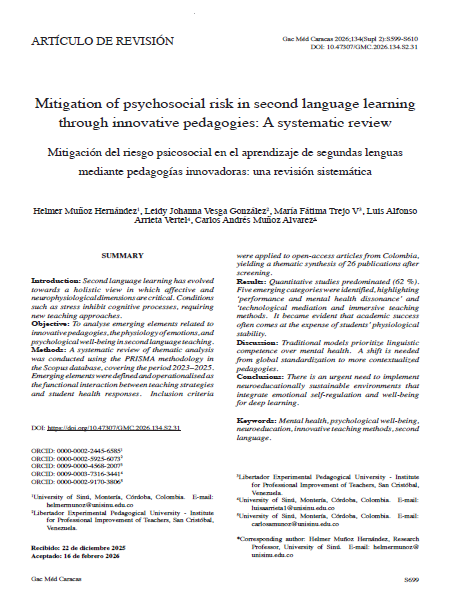
Mitigation of psychosocial risk in second language learning through innovative pedagogies: A systematic review
Mitigación del riesgo psicosocial en el aprendizaje de segundas lenguas mediante pedagogías innovadoras: una revisión sistemática
Palabras clave:
Mental health, psychological well-being, neuroeducation, innovative teaching methods, second languageResumen
Introduction: Second language learning has evolved towards a holistic view in which affective and neurophysiological dimensions are critical. Conditions such as stress inhibit cognitive processes, requiring new teaching approaches. Objective: To analyse emerging elements related to innovative pedagogies, the physiology of emotions, and psychological well-being in second language teaching. Methods: A systematic review of thematic analysis was conducted using the PRISMA methodology in the Scopus database, covering the period 2023–2025. Emerging elements were defined and operationalised as the functional interaction between teaching strategies and student health responses. Inclusion criteria were applied to open-access articles from Colombia, yielding a thematic synthesis of 26 publications after screening.
Descargas
Publicado
Cómo citar
Número
Sección
Licencia
Derechos de autor 2026 Gaceta Médica de Caracas

Esta obra está bajo una licencia internacional Creative Commons Atribución-NoComercial 4.0.