Telebachilleratos in upper secondary education: towards epistemic justice
DOI:
https://doi.org/10.55560/arete.2026.23.12.7Keywords:
Community education, high school education, epistemic justice and injustice, curriculumAbstract
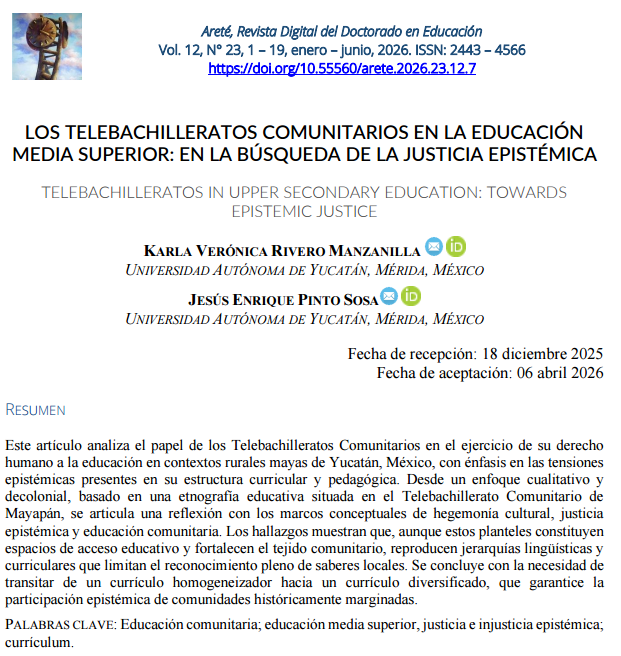
This article analyzes the role of Telebachilleratos Comunitarios in exercising their human right to education within rural maya contexts in Yucatán, Mexico, with an emphasis on the epistemic tensions embedded in their curricular and pedagogical structures. Adopting a qualitative and decolonial approach, and based on situated educational ethnography conducted at the Telebachillerato Comunitario of Mayapán, the study articulates a reflection grounded in the conceptual frameworks of cultural hegemony, epistemic justice, and community education. The findings reveal that although these schools provide access to education and strengthen community ties, they also reproduce linguistic and curricular hierarchies that constrain the full recognition of local knowledge. The article concludes by underscoring the need to move beyond homogenizing curricula toward educational models that ensure the epistemic participation of historically marginalized communities.
References
Angulo López, G. (2023). La eficacia real de los derechos humanos desde una perspectiva sociológica. Revista Estudios Jurídicos. Segunda Época, 23, 1–30. https://doi.org/10.17561/rej.n23.7542
Blanco, E. (2021). Evolución de las desigualdades educativas. Hacia una inclusión precaria. En E. Altamirano y L. Flamand (Eds.), Desigualdades sociales en México (pp. 59–100). Colegio de México. https://about.jstor.org/terms
Bourdieu, P. (2000). Poder, derecho y clases sociales. Desclée de Brouwer.
Bourdieu, P., y Passeron, J. C. (1996). La reproducción. Distribuciones Fontamara, S.A.
Castillo Rocha, Carmen, Pinto Loría, M. de Lourdes y Sidorova, Ksenia. (2020). Recordando a Mayapán y a sus personas. UADY, Universidad Autónoma de Yucatán.
Connel, R. W. (2006). La justicia curricular. En Escuela y justicia social (pp. 63–79).
Consejo Nacional de Educación de la Política de Desarrollo Social. (2020). Persisten brechas territoriales y entre grupos de población en el acceso a la educación. https://www.coneval.org.mx/SalaPrensa/Comunicadosprensa/Documents/2020/NOTA_DIA_INTERNACIONAL_DE_EDUCACION.pdf
Data México. (2023). Mayapán. Municipio de Yucatán. Gobierno de México. Secretaría de Economía.
Fonseca Largo, C. E. (2023). El currículum intercultural y el sistema educativo formal. Revista semestral, 7(Edición especial), 1–16.
Fricker, M. (2021). Conceptos de injusticia epistémica en evolución. Las Torres de Lucca. International Journal of Political Philosophy, 10(19), 97–103. https://doi.org/10.5209/ltdl.76466
Gramsci, A. (1980). Notas sobre Maquiavelo, sobre la política y sobre el Estado Moderno. Ediciones Nueva Visión.
Gramsci, A. (2016). Hegemonía y lucha política en Gramsci: Selección de textos (Varesi, G. Comp.). Luxemburg.
Grau-Grau, M. (2022). La ilusión del mérito: Capital cultural y reproducción. Revista Española de Sociología (RES), 31(3), 1–24. https://doi.org/10.22325/fes/res.2022
Guevara Niebla, G. (2022). El carácter político explícito de la reforma de la SEP y sus paradojas. En La educación en peligro. Análisis crítico de la reforma educativa 2022. Universidad de Guadalajara.
Instituto Nacional de Estadística y Geografía. (2020). Principales resultados del Censo de Población y Vivienda 2020. Yucatán. https://www.inegi.org.mx/contenidos/productos/prod_serv/contenidos/espanol/bvinegi/productos/nueva_estruc/702825198060.pdf
Instituto Nacional de Estadística y Geografía. (2022a). Encuesta Nacional Sobre Acceso y Permanencia en la Educación (ENAPE) 2021. https://www.inegi.org.mx/contenidos/saladeprensa/boletines/2022/ENAPE/ENAPE2021.pdf
Instituto Nacional de Estadística y Geografía. (2022b). Estadísticas a propósito del Día Internacional de los Pueblos Indígenas. https://www.inegi.org.mx/contenidos/saladeprensa/aproposito/2022/EAP_PueblosInd22.pdf
Jiménez Naranjo, Y. (2012). Desafíos conceptuales del currículum intercultural con perspectiva comunitaria. Revista Mexicana de Investigación Educativa, 17(52), 167–189. https://openurl.ebsco.com/contentitem/eue:84201752?sid=ebsco:plink:crawler&id=ebsco:eue:84201752&crl=c
Mandujano Estrada, M. (2017). Justicia epistémica y epistemologías del sur. Oxímora. Revista internacional de ética y política, 10, 148–164.
Martínez Buenabad, E. (2015). La educación intercultural y bilingüe (EIB) en México. ¿El camino hacia la construcción de una ciudadanía democrática? Relaciones, 141, 185–392.
Muñoz, G., y Camacho, S. (2019). Implementación errática del Marco Curricular Común de la RIEMS en Aguascalientes. Revista Electrónica de Investigación Educativa, 21, 1–12. https://doi.org/10.24320/REDIE.2019.21.E35.1938
Navarro Martínez, S. I. (2020). La interculturalidad: una aproximación teórica. En Discursos y prácticas de la educación superior intercultural (pp. 25–85). CLACSO. https://www.jstor.org/stable/j.ctv253f4sq.5
Pöllmann, A. (2017). Intercultural Education and the Realization of Intercultural Capital in Mexico. iMex. México interdisciplinario, 6(12), 80–93. https://doi.org/10.23692/iMex.12
Quijano, A. (2019). Colonialidad del poder, raza y capitalismo. Debates en Sociología, (49), 165–180. https://doi.org/10.18800/debatesensociologia.201902.010
Quijano, A. (2020). Colonialidad del poder, eurocentrismo y América Latina. En Cuestiones y horizontes. CLACSO. https://doi.org/10.2307/j.ctv1gm019g.31
Romero Morante, J., y Louzao Suárez, M. (2017). Educación para una ciudadanía intercultural y rendición de cuentas. Una mirada desde la historia de las asignaturas escolares. Espacio, Tiempo y Educación, 4(2), 121–142. https://doi.org/10.14516/ete.179
Rosa, C. (2021). ¿Del Monólogo al Diálogo de Saberes? Una Reflexión Epistemológica y Pedagógica sobre la Incorporación de los Saberes Tradicionales Indígenas en la Educación Intercultural Básica en México. Education Policy Analysis Archives, 29(102), 1–25. https://doi.org/10.14507/EPAA.29.5058
Salazar Jasso, A. (2021). SABERES RURALES EN EL SISTEMA EDUCATIVO MEXICANO: SIGNIFICADOS COMUNITARIOS EN EL NORESTE DEL PAÍS. Revista de Ciencias Sociales (Cr), II(172), 109–124. https://www.redalyc.org/articulo.oa?
Santos, B. de S. (2006). La Sociología de las Ausencias y la Sociología de las Emergencias: para una ecología de saberes. En Renovar la teoría crítica y reinventar la emancipación social (encuentros en Buenos Aires) (p. 108). CLACSO, Consejo Latinoamericano de Ciencias Sociales. http://bibliotecavirtual.clacso.org.ar/clacso/coediciones/20100825033033/2CapituloI.pdf
Secretaría de Educación Pública. (2019). Ley General de Educación. Diario Oficial de la Federación. https://www.diputados.gob.mx/LeyesBiblio/pdf/LGE.pdf
Secretaría de Educación Pública. (2024). Documento base 2024-2025. Telebachillerato Comunitario. https://dgb.sep.gob.mx/storage/recursos/2025/06/Zn14N7DbPR-Documento-Base-para-el-Servicio-Educativo-de-Telebachillerato-Comunitario-2024-2025.pdf
Secretaría de Educación Pública. (2025). Marco Curricular de la Educación Media Superior. Modelo educativo 2025. https://www.gob.mx/cms/uploads/attachment/file/1023480/2025_1_BN_MODELO_EDUCATIVO_2025_MCCMS.pdf
Subsecretaría de Educación Media Superior. (2024). Documento Base para el Bachillerato General. https://dgb.sep.gob.mx/storage/recursos/2024/02/FsPNWZjKIZ-Documento%20Base%20para%20el%20Bachillerato%20General.pdf
Serrano, S. (2013). Obligaciones del Estado frente a los derechos humanos y sus principios rectores: una relación para la interpretación y aplicación de los derechos. http://biblio.juridicas.unam.mx
Torres Santomé, J. (2012). La justicia curricular: El caballo de Troya de la cultura escolar. Ediciones Morata.
Walsh, C. (2010). Interculturalidad crítica y educación intercultural. En Construyendo Interculturalidad Crítica (pp. 75–96). Convenio Andrés Bello, Instituto Interamericano de Integración.
Walsh, C. (2012). Interculturalidad y (de)colonialidad: Perspectivas críticas y políticas. Visão Global, Joaçaba, 15(1–2), 61–74. https://periodicos.unoesc.edu.br/visaoglobal/article/view/3412/1511
Walsh, C. (2013). Prefacio. En C. Walsh (Ed.), Pedagogías decoloniales. Prácticas insurgentes de resistir, (re)existir y (re)vivir. TOMO 1: Vol. Tomo 1. Ediciones Abya Yala.
Weiss Horz, E. (2017). Modelo de Telebachillerato Comunitario y su operación en los estados. Instituto Nacional para la Evaluación de la Educación. www.inee.edu.mx
Published
How to Cite
Issue
Section
License
Copyright (c) 2026 Karla Verónica Rivero Manzanilla, Jesús Enrique Pinto Sosa

This work is licensed under a Creative Commons Attribution-NonCommercial-NoDerivatives 4.0 International License.
This journal provides free, immediate access to its content under the principle of making research freely available to the public, which fosters a greater exchange of global knowledge.
Authors who publish in Areté, Revista Digital del Doctorado en Educación, agree to the following terms:
- Authors retain copyright and grant the journal the right to be the first publication of the work, as well as licensed under a Creative Commons Attribution License that allows others to share the work with an acknowledgement of authorship of the work and initial publication in this journal.
- Authors may separately establish additional agreements for the non-exclusive distribution of the version of the work published in the journal (for example, placing it in an institutional repository or publishing it in a book), with an acknowledgement of its initial publication in this journal and not to be used for commercial purposes.
- The contents and images included in the articles are the responsibility of the author(s). Areté, Revista Digital del Doctorado en Educación, is not responsible for the information included in them.
- Authors agree with the license of use used by the journal, with the self-archiving conditions and with the open access policy.
- Authors are allowed to disseminate electronically (e.g., in institutional repositories or on their own website) the published version of their work, as it favors its earlier circulation and dissemination and thus a possible increase in its citation and reach among the academic community.
- In case of reuse of published works, the existence and specifications of the license of use must be mentioned, as well as the authorship and original source of publication.