Decision-making experiences and academic autonomy in higher education students
DOI:
https://doi.org/10.55560/arete.2026.24.12.20Keywords:
Student autonomy, decision-making, self-regulation, student experience, higher educationAbstract
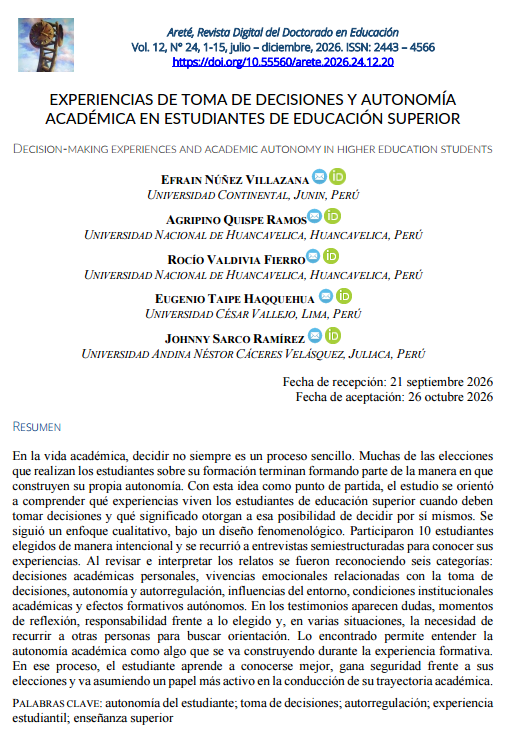
In academic life, making decisions is not always a simple process. Many of the choices students make regarding their education become part of how they build their own autonomy. With this as a starting point, the study aimed to understand the experiences of higher education students when faced with decision-making, as well as the meaning they attribute to the opportunity to decide for themselves. A qualitative approach was employed, using a phenomenological design. Ten students were selected through purposive sampling, and semi-structured interviews were conducted to explore their experiences. Through the review and interpretation of their accounts, six categories were identified: personal academic decisions, emotional experiences related to decision-making, autonomy and self-regulation, environmental influences, institutional academic conditions, and the autonomous effects on personal development. The participants' accounts reveal doubts, moments of reflection, a sense of responsibility for their choices, and, in various instances, the need to seek guidance from others. These findings suggest that academic autonomy is something that is constructed throughout the educational experience. In this process, students come to know themselves better, gain confidence in their choices, and take on a more active role in shaping their own academic trajectories.
References
Ajjawi, R., et al. (2024). Researching lived experience in health professional education. Medical Education. https://doi.org/10.1111/medu.15361
Bonyadi, A. (2023). Phenomenology as a research methodology in teaching English as a foreign language. Asian-Pacific Journal of Second and Foreign Language Education, 8, 11. https://doi.org/10.1186/s40862-022-00184-z
Chikobola, M. M. y Mutono-Mwanza, B. G. (2026). La fenomenología hermenéutica como práctica metodológica: interpretación de la experiencia vivida en la investigación cualitativa. Revista Trimestral Africana de Ciencias Sociales, 3(1), 107-120. https://doi.org/10.51867/AQSSR.3.1.10
Cullen, S., & Oppenheimer, D. (2024). Choosing to learn: The importance of student autonomy in higher education. Science Advances, 10(29), eado6759. https://doi.org/10.1126/sciadv.ado6759
D’Arrigo, S., Leonida, L., Maimone Ansaldo Patti, D., Muzzupappa, E., & Navarra, P. (2024). Autonomy in decision-making and freshmen’s performance at university: evidence from Italy. Studies in Higher Education, 1–15. https://doi.org/10.1080/03075079.2024.2367144
De Boer, M., & Zeiler, K. (2024). Qualitative critical phenomenology. Phenomenology and the Cognitive Sciences.
Flores-Buils, R. and Mateu-Pérez, R. (2025), Influence of Decision-Making Styles on Academic Stress and Resilience: An Approach for Educational Intervention. Psychology in the Schools, 62: 4170-4179. https://doi.org/10.1002/pits.23603
Fujii, A. (2024). Exploring autonomy support and learning preference in higher education: introducing a flexible and personalized learning environment with technology. Discover Education, 3(1). https://doi.org/10.1007/s44217-024-00111-z
Gil, S., Farré, M., Arboix, P., & Tarabini, A. (2026). Educational choices and social inequalities: How research addresses students' decision-making. European Journal of Education, 61(2), e70648. https://doi.org/10.1111/ejed.70648
Hartnett, M., Brown, C., Forbes, D., Gedera, D., & Datt, A. (2023). Enhanced or diminished attitudes: University students’ agency. Computers & Education, 198(104773), 104773. https://doi.org/10.1016/j.compedu.2023.104773
Ho, K.H.M., Cheung, D.S.K., Bourke, S. and Edvardsson, D. (2026), Reflexivity in Heideggerian Hermeneutic Phenomenology: The Hermeneutic Phenomenological Circle. J Adv Nurs, 82: 957-965. https://doi.org/10.1111/jan.16950
Jimenez, P. C., Zwickle, A., & Dauer, J. M. (2024). Defining and describing students’ socioscientific issues tradeoffs practices. International Journal of Science Education Part B, 14(3), 277–293. https://doi.org/10.1080/21548455.2023.2263608
Kinsella, M., Wyatt, J., Nestor, N., Last, J., & Rackard, S. (2024). Fostering students’ autonomy within higher education: the relational roots of student adviser supports. Irish Educational Studies, 43(4), 1189–1208. https://doi.org/10.1080/03323315.2023.2201229
Le, H. T. T., Phan, L. T., & Vu, H. T. T. (2022). Student decision-making processes as evaluated by students, administrators, and lecturers. International Journal of Education and Practice, 10(4), 371–380. https://doi.org/10.18488/61.v10i4.3221
Lincoln, Y. S., & Guba, E. G. (1985). Naturalistic inquiry. SAGE Publications.
Mameli, C., Grazia, V., & Molinari, L. (2023). Student agency: Theoretical elaborations and implications for research and practice. International Journal of Educational Research, 122(102258), 102258. https://doi.org/10.1016/j.ijer.2023.102258
Mares-Ruiz, C. M., Cardoza-Sernaqué, L. S., Jiménez-Jáuregui, Y. J., Belleza-Torrejón, S. E., Salas-Torres, L. M., & Peláez-Valdivieso, J. V. (2023). Autonomous learning in higher education students: A systematic review of the literature on WoS between 2019-2022. International Journal of Membrane Science and Technology, 10(4), 423–433. https://doi.org/10.15379/ijmst.v10i4.2060
Martínez-Clares, P., González Morga, N., González Lorente, C., & Pérez Cusó, J. (2024). toma de decisiones en Educación Superior. Análisis de competencias transversales. Profesorado (Granada), 28(1), 263–280. https://doi.org/10.30827/profesorado.v28i1.28001
Park, S., Nam, J. K., & Kim, K. (2025). Helicopter parenting and career decision-making in university students: Mediation by fear of failure and self-efficacy. Journal of Career Development, 08948453251363222. https://doi.org/10.1177/08948453251363222
Sincer, S., & Özek, B. Y. (2024). Unveiling learner autonomy: Perspectives of university students in online education. International Online Journal of Education & Teaching, 11(3), 600–618. https://iojet.org/index.php/IOJET/article/view/2117
Tang, K.-S., McLure, F., Williams, J., & Donnelly, C. (2024). Investigating the role of self-selected STEM projects in fostering student autonomy and self-directed learning. Australian Educational Researcher. https://doi.org/10.1007/s13384-024-00696-2
Waltzer, K., Kärkkäinen, S., & Havu-Nuutinen, S. (2025). Early childhood professionals’ pedagogical decision making. International Journal of Early Years Education, 33(2), 261–271. https://doi.org/10.1080/09669760.2023.2261496
Published
How to Cite
Issue
Section
License
Copyright (c) 2026 Efraín Núñez Villazana, Agripino Quispe Ramos, Rocío Valdivia Fierro, Eugenio Taipe Haqquehua, Johnny Sarco Ramírez

This work is licensed under a Creative Commons Attribution-NonCommercial-NoDerivatives 4.0 International License.
This journal provides free, immediate access to its content under the principle of making research freely available to the public, which fosters a greater exchange of global knowledge.
Authors who publish in Areté, Revista Digital del Doctorado en Educación, agree to the following terms:
- Authors retain copyright and grant the journal the right to be the first publication of the work, as well as licensed under a Creative Commons Attribution License that allows others to share the work with an acknowledgement of authorship of the work and initial publication in this journal.
- Authors may separately establish additional agreements for the non-exclusive distribution of the version of the work published in the journal (for example, placing it in an institutional repository or publishing it in a book), with an acknowledgement of its initial publication in this journal and not to be used for commercial purposes.
- The contents and images included in the articles are the responsibility of the author(s). Areté, Revista Digital del Doctorado en Educación, is not responsible for the information included in them.
- Authors agree with the license of use used by the journal, with the self-archiving conditions and with the open access policy.
- Authors are allowed to disseminate electronically (e.g., in institutional repositories or on their own website) the published version of their work, as it favors its earlier circulation and dissemination and thus a possible increase in its citation and reach among the academic community.
- In case of reuse of published works, the existence and specifications of the license of use must be mentioned, as well as the authorship and original source of publication.