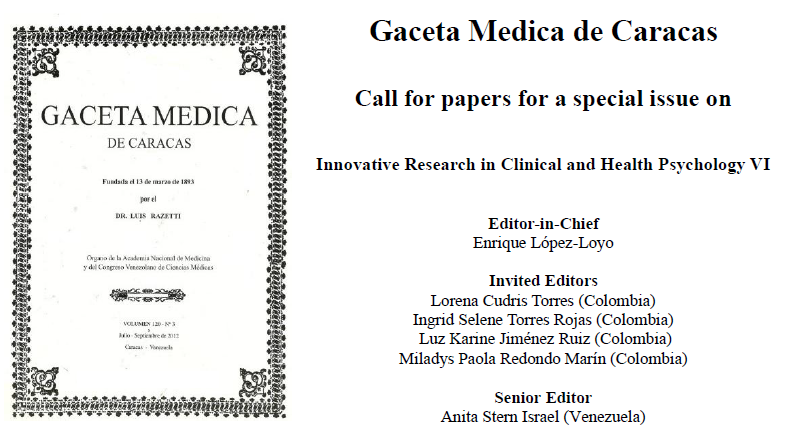
Call for papers for a special issue on Innovative Research in Clinical and Health Psychology VI
Dear Colleagues:
Clinical psychology advances scientific understanding, assessment, prevention, and treatment of mental,
emotional, and behavioral health conditions. Contemporary research integrates evidence-based
psychological interventions, clinical neuroscience, process-based and contextual approaches, and
culturally responsive care. Particular attention is needed on intervention effectiveness, therapeutic
processes, patient-reported outcomes, and translating research findings into accessible, person-centered
clinical practice.
Health psychology examines how psychological, behavioral, social, cultural, and environmental factors
shape physical health, illness experiences, and health-related quality of life across the lifespan. It
contributes to health promotion, disease prevention, behavioral medicine, chronic condition management,
treatment adherence, and the development and evaluation of interventions that support patients, families,
and communities.
Together, clinical and health psychology address complex and interconnected challenges, including
mental health inequities, suicide prevention, multimorbidity, population aging, occupational well-being,
and the responsible use of digital technologies. This special issue welcomes theoretically grounded and
methodologically rigorous work that advances equitable, ethical, and context-sensitive psychological
care across diverse settings and populations.
The sixth special issue, Innovative Research in Clinical and Health Psychology VI, invites early-career
and established researchers to submit original contributions, including interdisciplinary and cross-
cultural studies, on the following topics (without being limited to them):
- Evidence-based psychological assessment, diagnosis, prevention, and intervention across clinical
settings. - Psychotherapy effectiveness, mechanisms of change, personalized interventions, and treatment
outcomes. - Transdiagnostic and process-based approaches to mental health and psychological well-being.
- Epidemiology, determinants, and prevention of depression, anxiety, trauma-related conditions,
substance use, and suicidal behavior. - Digital mental health, telepsychology, mobile health interventions, and hybrid models of
psychological care. - Artificial intelligence in mental health: clinical validity, safety, human oversight, privacy, bias,
and ethical governance. - Development, adaptation, validation, and cross-cultural measurement invariance of
psychological instruments using contemporary psychometric methods. - Innovative quantitative, qualitative, mixed-methods, longitudinal, and intensive longitudinal
approaches in clinical and health psychology. - Cognitive, affective, behavioral, and neuropsychological processes associated with health and
illness. - Psychological interventions for chronic diseases, pain, cancer, disability, and multimorbidity;
treatment adherence and quality of life. - Occupational mental health, psychosocial risks, burnout, work-related stress, and organizational
well-being. - Child and adolescent mental health, developmental trajectories, early intervention, and family-
centered care. - Healthy aging, cognitive health, loneliness, caregiving, and psychological well-being in later life.
14. Mental health literacy, psychoeducation, prevention programs, and school- and university-based
interventions. - Health behaviors, sleep, physical activity, nutrition, self-management, and sustainable behavior
change. - Neurodevelopmental conditions, disability, accessibility, and inclusive psychological services.
- Social determinants of mental health, structural inequities, stigma, cultural diversity, and
underserved populations. - Community-based, territorial, and culturally responsive mental health care, including
implementation and service evaluation. - Mental health in emergencies, displacement, migration, violence, climate-related adversity, and
other contexts of psychosocial vulnerability. - Integration of mental and physical health care, collaborative care, health-system innovation, and
implementation science.
Manuscript Submission Information
Gaceta Médica de Caracas is an international peer-reviewed open-access quarterly journal published by
La Academia Nacional de Medicina, Caracas, Venezuela. Manuscripts should be submitted online to
cudristorreslorena@gmail.com by the deadline. Accepted papers will be published on the platforms of
the Academia Nacional de Medicina and Saber UCV (http://saber.ucv.ve/ojs/index.php/rev_gmc) and
listed together on the special issue website. Research articles, review articles, and short communications
are invited.
Submitted manuscripts should not have been published previously, nor be under consideration for
publication elsewhere. All manuscripts are thoroughly refereed through a rigorous double-blind peer-
review process.
A guide for authors and other relevant information for the submission of manuscripts is available on the
Instructions for Authors page. Each author must provide their personal ORCID ID number and e-mail.
Please visit the Instructions for Authors page before submitting a manuscript. Submitted papers should
be well-formatted and written in good scientific English.
Authors must disclose any use of artificial intelligence (AI) tools or AI-assisted technologies in the
preparation of the manuscript, as detailed in the author guidelines.
Deadline for submissions: December 15th, 2026.
Article Processing Charges (APC)
Authors pay a one-time Article Processing Charge (APC) of 265 USD once the manuscript has been
accepted for publication (after a peer review process by 3 referees) by the Editor-in-Chief. The APC will
cover the costs of peer review administration and management, professional production of articles in
PDF, and dissemination of published papers in various venues, in addition to other publishing functions.
There are no charges for rejected articles, no submission charges, and no surcharges based on the length
of an article or figures. Some items (Editorials, Corrections, Addenda, and Retractions) are published
free of charge. Papers submitted from Editorial Board Members (EBM), Venezuelan Research Groups,
and upon EBM request will be published free of charge.
Invited Editors
Lorena Cudris Torres, PhD (Colombia)
Ingrid Selene Torres Rojas, PhD (Colombia)
Luz Karine Jiménez Ruiz, PhD (Colombia)
Miladys Paola Redondo Marín, Mr (Colombia)