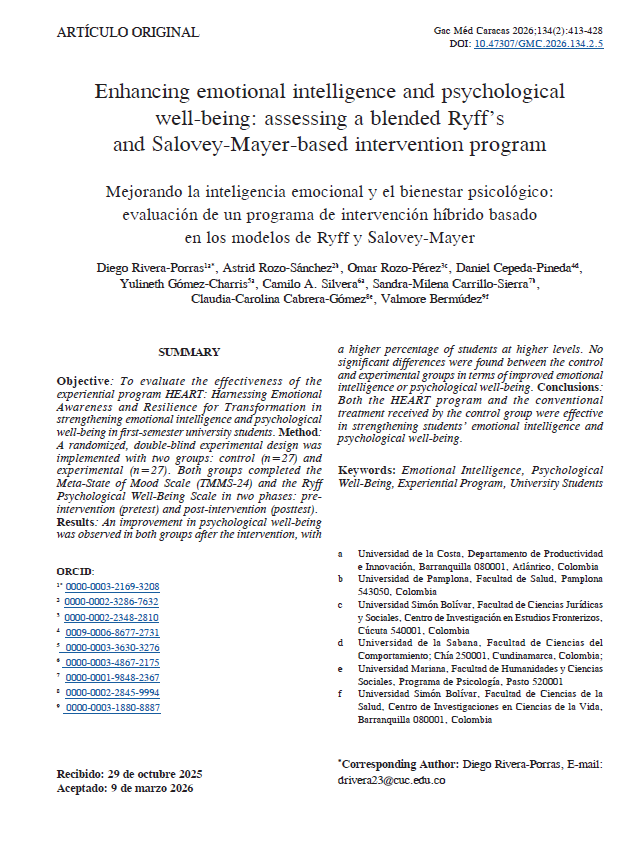
Enhancing emotional intelligence and psychological well-being: assessing a blended Ryff’s and Salovey-Mayer-based intervention program
Mejorando la inteligencia emocional y el bienestar psicológico: evaluación de un programa de intervención híbrido basado en los modelos de Ryff y Salovey-Mayer
Palabras clave:
Emotional Intelligence, Experiential Program, Psychological Well-Being, University StudentsResumen
Objective: To evaluate the effectiveness of the experiential program HEART: Harnessing Emotional Awareness and Resilience for Transformation in strengthening emotional intelligence and psychological well-being in first-semester university students. Method: A randomized, double-blind experimental design was implemented with two groups: control (n=27) and experimental (n=27). Both groups completed the Meta-State of Mood Scale (TMMS-24) and the Ryff Psychological Well-Being Scale in two phases: pre-intervention (pretest) and post-intervention (posttest). Results: An improvement in psychological well-being was observed in both groups after the intervention, with a higher percentage of students at higher levels. No significant differences were found between the control and experimental groups in terms of improved emotional intelligence or psychological well-being. Conclusions: Both the HEART program and the conventional treatment received by the control group were effective in strengthening students’ emotional intelligence and psychological well-being.
Descargas
Publicado
Cómo citar
Número
Sección
Licencia
Derechos de autor 2026 Gaceta Médica de Caracas

Esta obra está bajo una licencia internacional Creative Commons Atribución-NoComercial 4.0.