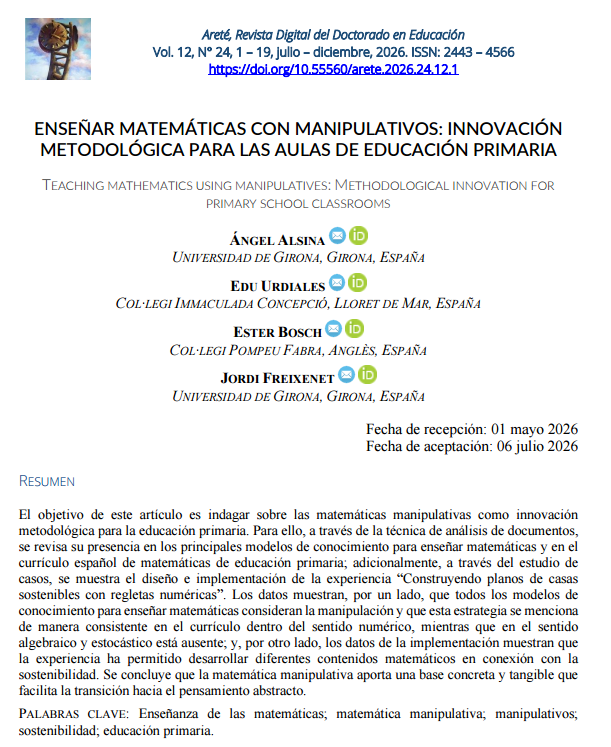
Teaching mathematics using manipulatives: Methodological innovation for primary school classrooms
DOI:
https://doi.org/10.55560/arete.2026.24.12.1Keywords:
Teaching of mathematics, manipulative mathematics, manipulatives, sustainability, primary educationAbstract
The aim of this article is to explore manipulative mathematics as a methodological innovation in primary education. To this end, using document analysis, the study examines their presence in the main knowledge models for teaching mathematics and in the Spanish primary school mathematics curriculum; furthermore, through a case study, it illustrates the design and implementation of the activity ‘Building plans for sustainable houses using number strips’. The data show, on the one hand, that all knowledge models for teaching mathematics take manipulation into account and that this strategy is consistently mentioned in the curriculum within the numerical domain, whilst it is absent from the algebraic and stochastic domains; and, on the other hand, the implementation data show that the activity has enabled the development of various mathematical concepts in connection with sustainability. It is concluded that manipulative mathematics provides a concrete and tangible basis that facilitates the transition to abstract thinking.
References
Alsina, Á. (2006). Cómo desarrollar el pensamiento matemático de 0 a 6 años. Octaedro.
Alsina, Á. (2020). El Enfoque de los Itinerarios de Enseñanza de las Matemáticas: ¿por qué?, ¿para qué? y ¿cómo aplicarlo en el aula? Tangram: Revista de Educação Matemática, 3(2), 127–159. https://doi.org/10.30612/tangram.v3i2.12018
Alsina, Á. (2022). On Integrating Mathematics Education and Sustainability in Teacher Training: Why, to What End and How? En D. Ortega-Sánchez (Ed.), Controversial Issues and Social Problems for an Integrated Disciplinary Teaching. Integrated Science, vol 8. (pp. 9-21). Springer. https://doi.org/10.1007/978-3-031-08697-7
Alsina, Á. y Bosch, E. (2025). Las regletas numéricas: oportunidades para desarrollar el pensamiento matemático (3-12 años). Números: Revista de Didáctica de las Matemáticas, 121, 71–93.
Alsina, Á. y Delgado-Rebolledo, R. (2022). ¿Qué conocimientos necesita el profesorado de Educación Infantil para enseñar matemáticas? Matemáticas, Educación y Sociedad, 5(1), 18–37.
Alsina, Á. y Planas, N. (2008). Matemática inclusiva: propuestas para una educación matemática accesible. Narcea.
Arnal-Bailera, A. y Arnal-Palacián, M. (2023). Pre-service teachers develop their mathematical knowledge for teaching using manipulative materials in mathematics. Eurasia Journal of Mathematics, Science and Technology Education, 19(9), em2318. https://doi.org/10.29333/ejmste/13470
Ball, D., Thames, M. H., y Phelps, G. (2008). Content knowledge for teaching: What makes it special? Journal of Teacher Education, 59(5), 389-407. https://doi.org/10.1177/0022487108324554
Canals, M. A. (2001). L’ús del material manipulable en l’aprenentatge de la matemàtica. Perspectiva Escolar, 254, 48-55.
Carrillo-Yañez, J., Climent, N., Montes, M., Contreras, L.C., Flores-Medrano, E., Escudero-Ávila, D., Vasco, D., Rojas, N., Flores, P., Aguilar-González, A., Ribeiro, M., y Muñoz-Catalán; Mª.C. (2018). The mathematics teacher’s specialised knowledge (MTSK) model. Research in Mathematics Education, 20, 236–253. https://doi.org/10.1080/14794802.2018.1479981
Cuisenaire, G. (1952). Les nombres en couleurs. Nouveau procédé de calcul par la método active, applicable à tous les degrés de l’école primaire. Duculot-Roulin.
Dienes, Z. P. (1966). La construcción de las matemáticas. Teide.
Escudero-Ávila, D., Contreras, L. C. y Vasco, D. (2016). Conocimiento de la enseñanza de la matemáticas (KMT). En J. Carrillo, L. C. Contreras y M. Montes (Eds.), Reflexionando sobre el conocimiento del profesor. Actas de las II Jornadas del Seminario de Investigación de Didáctica de la Matemática de la Universidad de Huelva (pp. 35-41). SGSE.
Gattegno, C. (1953). Numbers in colour. Bulletin of the Association for Teaching Aids in Mathematics, 2, 5-7.
Gattegno, C. (1954). Les nombres en couleurs de Cuisenaire. Moniteur des Instituteurs et des Institutrices Primaires, 72(11), 162-163.
Gattegno, C. (1955). Les nombres en couleurs de Georges Cuisenaire. Mathematica & Paedagogia, 4, 17-22.
Godino, J. D., Giacomone, B., Batanero, C. y Font, V. (2017). Enfoque ontosemiótico de los conocimientos y competencias del profesor de matemáticas. Bolema: Boletim de Educação Matemática, 31(57), 90–113. http://dx.doi.org/10.1590/1980-4415v31n57a05
McMillan, J. H. y Schumacher, S. (2005). Investigación educativa: una introducción conceptual (5.ª ed.). Pearson Educación.
Ministerio de Educación y Formación Profesional [MEFP] (2022). Real Decreto 157/2022, de 1 de marzo, por el que se establecen la ordenación y las enseñanzas mínimas de la Educación Primaria. Boletín Oficial del Estado, (52), 24872-24951. https://www.boe.es/
Montessori, M. (1912). El método de la pedagogía científica aplicada a la educación de la infancia. Casa Editorial Araluce.
Piaget, J. (1975). Génesis de las estructuras lógicas elementales: clasificaciones y seriaciones. Guadalupe.
Rowland, T., Huckstep, P. y Thwaites, A. (2005). Elementary teachers' mathematics subject knowledge: The knowledge quartet and the case of Naomi. Journal of Mathematics Teacher Education, 8(3), 255–281. https://doi.org/10.1007/s10857-005-0853-5
Shulman, L. S. (1986). Those who understand: Knowledge growth in teaching. Educational researcher, 15(2), 4-14. https://doi.org/10.3102/0013189X015002004
Published
How to Cite
Issue
Section
License
Copyright (c) 2026 Angel Alsina, Edu Urdiales, Ester Bosch, Jordi Freixenet

This work is licensed under a Creative Commons Attribution-NonCommercial-NoDerivatives 4.0 International License.
This journal provides free, immediate access to its content under the principle of making research freely available to the public, which fosters a greater exchange of global knowledge.
Authors who publish in Areté, Revista Digital del Doctorado en Educación, agree to the following terms:
- Authors retain copyright and grant the journal the right to be the first publication of the work, as well as licensed under a Creative Commons Attribution License that allows others to share the work with an acknowledgement of authorship of the work and initial publication in this journal.
- Authors may separately establish additional agreements for the non-exclusive distribution of the version of the work published in the journal (for example, placing it in an institutional repository or publishing it in a book), with an acknowledgement of its initial publication in this journal and not to be used for commercial purposes.
- The contents and images included in the articles are the responsibility of the author(s). Areté, Revista Digital del Doctorado en Educación, is not responsible for the information included in them.
- Authors agree with the license of use used by the journal, with the self-archiving conditions and with the open access policy.
- Authors are allowed to disseminate electronically (e.g., in institutional repositories or on their own website) the published version of their work, as it favors its earlier circulation and dissemination and thus a possible increase in its citation and reach among the academic community.
- In case of reuse of published works, the existence and specifications of the license of use must be mentioned, as well as the authorship and original source of publication.