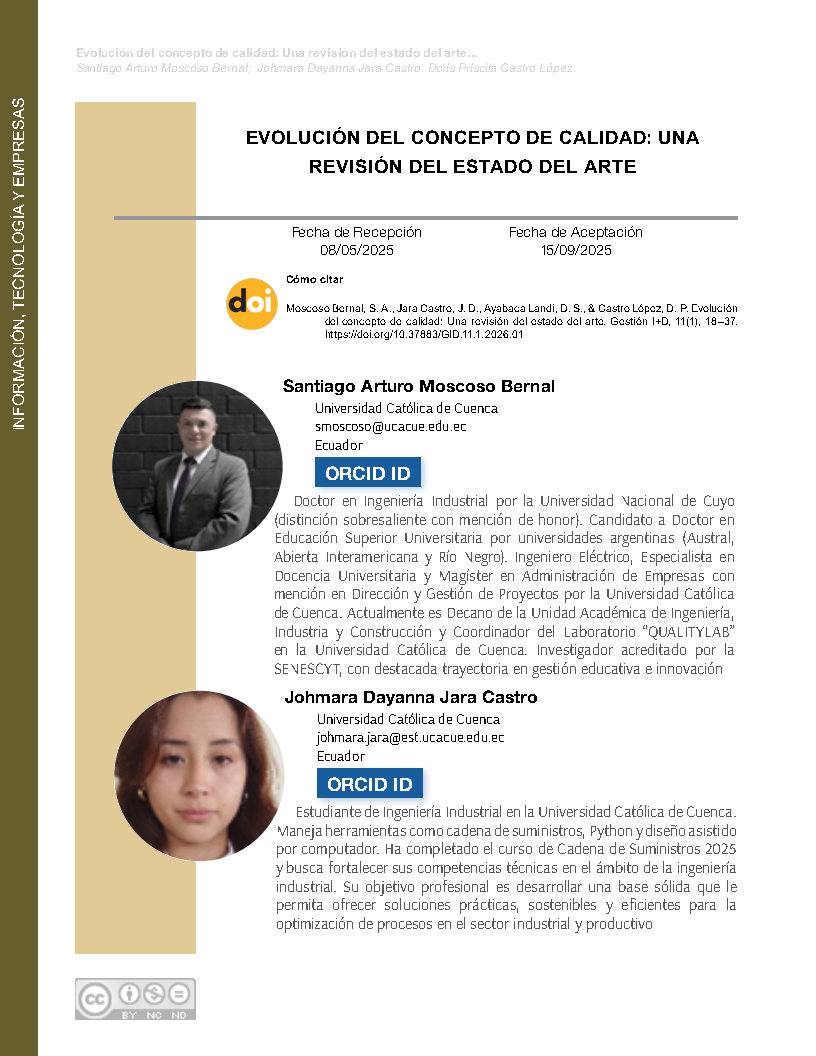
The evolution of the concept of quality: a review of the state of the art
DOI:
https://doi.org/10.37883/GID.11.1.2026.01Keywords:
Quality, total quality management, quality control, history of qualityAbstract
Referring to the definition of quality involves understanding a multidimensional concept that includes ideas and facts that span from the Middle Ages to postmodern times. Societies have sought to ensure that goods and services meet specific standards by adapting to diverse social and technological contexts, thereby creating a comprehensive view of quality. This article presents a set of definitions and approaches to the term “quality”, based on a state-of-the-art review of the literature. Its goal is to describe how the concept of quality has evolved, tracing a chronological path from its origins in craftsmanship to more complex and recent approaches linked to digital transformation and Industry 4.0. The methodology followed guidelines for systematic reviews of the literature in applied sciences. After applying inclusion and exclusion criteria, selected documents were analyzed thoroughly to identify key trends, paradigm shifts, and dominant quality models. The results show that the idea of quality has changed significantly over time. Initially, quality was focused on compliance with trade regulations and craftsmanship. During the Industrial Revolution, quality control through inspections and statistical tools was introduced in mass production
References
Ahuja, L., Yépez, N. B., & Pedroza, Á. R. (2019). La relación entre gestión de la calidad total (GCT) y gestión de la tecnología /I+D (GT/I+D) en empresas de manufactura en México. Contaduría y Administración, 65(1), 148. https://doi.org/10.22201/fca.24488410e.2019.1698
Benzaquen de las Casas, J. (2018). La ISO 9001 y la Administración de la Calidad Total en las Empresas Peruanas. Universidad & Empresa, 20(35), 281. https://doi.org/10.12804/revistas.urosario.edu.co/empresa/a.6056
Carriel, R. P., & Nieto, A. J. (2022). La evolución de la calidad hacia la calidad total. AlfaPublicaciones, 4(1.1), 383–397. https://doi.org/10.33262/ap.v4i1.1.166
Celis, O. L. M., & García, J. M. S. (2012). A technological approach to the development of logistic projects using “Lean Six Sigma.” Estudios Gerenciales, 28(124), 23–43. https://doi.org/10.1016/S0123-5923(12)70214-0
Chinchayhuara, D. J. D., Benites Castillo, M. G., Sánchez Vásquez, J. E., & Vásquez Díaz, A. M. (2022). The Adoption of Industry 4.0 and its Influence on the Improvement of the Quality of Life in Society 5.0: A systematic review. Gestión de Operaciones Industriales, 1(2), 9–24. https://doi.org/10.17268/goi4.0.2022.06
Cilla, A. (2004). El Modelo EFQM de Excelencia. Cuadernos de Gestión, xxxvii, 1–8. file:///D:/UCV 2020/IV CICLO - 2022/SILABO SISTEMA DE EVALUACIÓN EN EDUCACIÓN/LECTURAS/Dialnet-ElModeloEFQMDeExcelencia-892146.pdf
Cubillos, M., & Rozo, D. (2009). El concepto de calidad: Historia, evolución e importancia para la competitividad. Revista Universidad de La Salle, 0(48), 80–99. https://ciencia.lasalle.edu.co/cgi/viewcontent.cgi?article=1170&context=ruls
Deming, E. (2009). La salida de la crisis. Calidad, productividad y competitividad. http://www.calidad.com
Durán, S., Prieto, R., & García, J. (2017). Influencia de la Calidad de Vida en el rendimiento del Estudiante Universitario. Calidad de Vida, Inclusión Social y Bienestar Humano, 978–980. https://doi.org/10.21892/9789804270215.6
Elkington, J. (1999). Cannibals With Forks : Triple Bottom Line of 21st Century Business. https://books.google.com.ec/books/about/Cannibals_with_Forks.html?id=dIJAbIM7XNcC
Garvin, D. A. (1984). What Does “Product Quality” Really Mean? In Sloan management review (Vol. 26, Issue 1, pp. 25–43).
Juran, J. (1988). Juran on Planning for Quality. https://books.google.com.ec/books/about/Juran_on_Planning_for_Quality.html?id=q_kRiKQ8qSgC&redir_esc=y
Justiniano, A. (2023). Artificial intelligence in quality management and its importance. Gaceta Científica, 9(1), 5–7.
Kitchenham, Barbara and Charters, S. (2007). Guidelines for performing systematic literature reviews in software engineering. Technical Report, Ver. 2.3 EBSE Technical Report. EBSE, January 2007, 1–57.
Llanes, M., & Lorenzo, E. (2021). La cuarta revolución industrial y una nueva aliada: calidad 4.0. Ciencias Holguín, 27(2), 67–68. https://www.redalyc.org/articulo.oa?
Medici, L. (2020). ISO 9000: Evolución hacia la calidad total. Publicaciones En Ciencias y Tecnología, 14, 3–13. http://doi.org/10.13140/RG.2.2.27619.48162
Montes de Oca, H. (2021). Evolución del concepto calidad y aporte al desarrollo regenerativo desde la estrategia empresarial. Perspectiva Empresarial, 8, 48–64. https://doi.org/10.16967/23898186.717
Montgomery, D. (2009). Introduction to Statistical Quality Control 6th Edición. https://www.amazon.com/Introduction-Statistical-Quality-Control-Montgomery/dp/0470169923
Organización Internacional de Estandarización, (ISO). (2015). Norma Internacional ISO 9000: 2015. 2015, 2015, 1–60. www.iso.org
Ramirez, J. C. (2000). Historia de la Calidad. Zitteliana, 19(8), 159–170.
Roth, M. T. (1997). Law Collections from Mesopolamia and Asia Minor.
Sánchez, M. (2005). Calidad Total: Modelo EFQM de excelencia. https://books.google.es/books?hl=es&lr=&id=ZxYPb_6NcXsC&oi=fnd&pg=PA9&dq=Modelo+EFQM+&ots=qVBLKmMEcW&sig=-498ijdaq57exCD34TrjRcnc9GU#v=onepage&q=Modelo EFQM&f=false
Shewhart, W. A. (1931). Economic control of quality of manufactured product [Reimpresión de Dover Publications, 1986] (I. D. Van Nostrand Company (ed.)).
Sony, M. (2020). Essential ingredients for the implementation of Quality 4.0: A narrative review of literature and future directions for research. Emerald Logo, 32(4). https://doi.org/https://doi.org/10.1108/TQM-12-2019-0275
Torres, K., Ruiz, T., Solís, L., & Martínez, F. (2012). Calidad y su evolución : una revisión. Dimens. Empres, 10(2), 100–107.
Universidad Nacional Agraria la Molina. (2021). Sistema de Gestión de la Calidad Manual de la Calidad. 1–45.
Published
How to Cite
Issue
Section
Categories
License
Copyright (c) 2026 Santiago Arturo Moscoso Bernal, Johmara Dayanna Jara Castro, David Santiago Ayabaca Landi, Doris Priscila Castro López

This work is licensed under a Creative Commons Attribution-NonCommercial-NoDerivatives 4.0 International License.