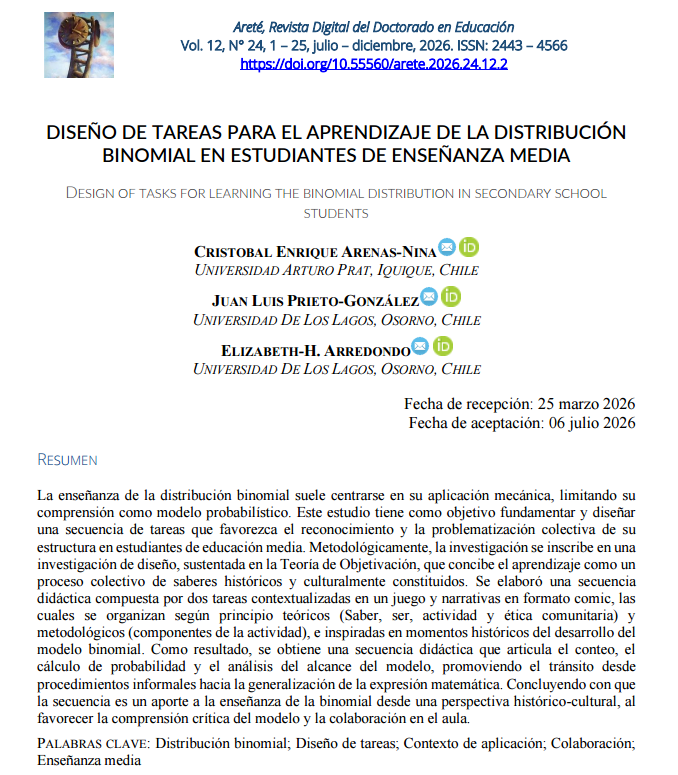
Design of tasks for learning the binomial distribution in secondary school students
DOI:
https://doi.org/10.55560/arete.2026.24.12.2Keywords:
Binomial distribution, Task design, Application contexts, Collaboration, Secondary educationAbstract
The teaching of the binomial distribution is often focused on its mechanical application, limiting its understanding as a probabilistic model. This study aims to provide a foundation for and design a sequence of tasks that promotes the recognition and collective problematization of its structure in secondary education students. Methodologically, the research is framed within design-based research, grounded in the Theory of Objectification, which conceives learning as a collective process of historically and culturally constituted knowledge. A didactic sequence composed of two tasks was developed, contextualized in a game and comic-format narratives, organized according to theoretical principles (knowledge, being, activity, and community ethics) and methodological principles (components of the activity), and inspired by historical moments in the development of the binomial model. As a result, a didactic sequence is obtained that articulates counting, probability calculation, and the analysis of the scope of the model, promoting the transition from informal procedures to the generalization of the mathematical expression. It is concluded that this sequence contributes to the teaching of the binomial distribution from a historical-cultural perspective, fostering a critical understanding of the model and collaboration in the classroom.
References
Álvarez Tinajero, N. M., Rivadeneira Flores, J. O., & Montero Zambrano, S. D. P. (2022). Dificultades en la enseñanza-aprendizaje de la estadística y probabilidad: Una perspectiva de estudiantes. Ecos de la Academia, 8(16), 81–97. https://doi.org/10.53358/ecosacademia.v8i16.772
Anderson, T., & Shattuck, J. (2012). Design-based research: A decade of progress in education research? Educational Researcher, 41(1), 16-25.
D’Amore, B., & Radford, L. (2017). Enseñanza y aprendizaje de las matemáticas: Problemas semióticos, epistemológicos y prácticos. Universidad Distrital Francisco José de Caldas.
de la Fuente, G. R. C. (2017). Evaluación de la idoneidad didáctica de una experiencia de enseñanza sobre distribuciones binomial y normal en 2.º de bachillerato [Trabajo de fin de máster, Universidad de Granada].
Devore, J. L. (2008). Probabilidad y estadística para ingeniería y ciencias (7.ª ed.). Cengage Learning.
Fernández Coronado, N. A., García-García, J. I., Arredondo, E. H., & Araya Naveas, I. A. (2022). Epistemic configurations and holistic meaning of binomial distribution. Mathematics, 10(10), 1748. https://doi.org/10.3390/math10101748
García-García, J. I., Arredondo, E., & Márques Torres, M. (2018). Desarrollo de la noción de distribución binomial en estudiantes de bachillerato con apoyo de tecnologia. PARADIGMA, 39(2), 92–106. https://doi.org/10.37618/PARADIGMA.1011-2251.2018.p92-106.id702
García-García, J. I., Fernández Coronado, N. A., Arredondo, E. H., & Imilpán Rivera, I. A. (2022). The Binomial Distribution: Historical Origin and Evolution of Its Problem Situations. Mathematics, 10(15), 2680. https://doi.org/10.3390/math10152680
Gómez, N. L. (2014). Creando, dibujando… aprendiendo matemática a través del cómic. Cuadernos de Investigación y Formación en Educación Matemática, 9(12), 111–123.
González, L. (2024). Azar: Algunas huellas de su constitución histórico-cultural. Paskín Matemático, 6(1), 34–44.
Landín, P. R., & Sánchez, E. (2010). Niveles de razonamiento probabilístico de estudiantes de bachillerato frente a tareas de distribución binomial. Educação Matemática Pesquisa, 12(3), 598–618.
Lasprilla, A., Radford, L., & León, O. L. (2021). La labor conjunta en actividades de enseñanza-aprendizaje a partir del estudio de los vectores de la ética comunitaria. REMATEC – Revista de Matemática, Ensino e Cultura, 16(39), 228–245.
Martínez Zambrano, W. A., & Pilcue Menza, L. J. (2020). Dificultades que presentan estudiantes de la licenciatura en educación básica con énfasis en matemáticas con respecto a la distribución binomial (Tesis de licenciatura). Universidad del Valle. https://hdl.handle.net/10893/20766
Millones, T. S. O., de Alencar, E. S., & Bueno, S. (2021). Dificultades en la enseñanza y el aprendizaje de la Estadística: comparación de investigaciones de Perú y Brasil entre los años 2009 a 2017. Research, Society and Development, 10(12), e36101219975.
Ministerio de Educación [MINEDUC]. (2016). Bases curriculares 7º básico a 2º medio. https://www.curriculumnacional.cl/sites/default/files/newtenberg/614/articles-37136_bases.pdf
Ministerio de Educación de Chile [MINEDUC]. (2021). Programa HC: Probabilidades y estadística descriptiva e inferencial 3° y 4° medio. https://www.curriculumnacional.cl/sites/default/files/newtenberg/614/articles-140145_programa_feb_2021_final_s_disegno.pdf
Pizarro-Ayavire, A. B., Prieto-González, J. L., & Gutiérrez-Araujo, R. E. (2024). Designing the encounter of teachers with meanings and levels of understanding of the derivative. International Electronic Journal of Mathematics Education, 19(4), em0798. https://doi.org/10.29333/iejme/15520
Pizarro-Ayavire, A. B., Prieto-González, J. L., & Gutiérrez-Araujo, R. E. (2026). El encuentro con las constelaciones como saber histórico-cultural. Revista de Investigación en Educación, 24(2), 394-417. https://doi.org/10.35869/reined.v24i2.6947
Pizarro-Ayavire, A. B., Prieto-González, J. L., Gutiérrez-Araujo, R. E., & Gobara, S. T. (En evaluación). Collective learning about constellations in High School: A theory of objectification approach.
Prieto G., J. L., & Arredondo, E.-H. (2020). Aprendizaje de las construcciones euclidianas con GeoGebra: Elementos de una actividad formativa para futuros profesores de matemáticas. Paradigma, 356–380. https://doi.org/10.37618/PARADIGMA.1011-2251.0.p356-380.id976
Prieto G., J. L., & Arredondo, E.-H. (2022). Diseño de un entorno de aprendizaje del saber docente acerca de las construcciones euclidianas con GeoGebra. Educación Matemática, 34(2), 7-38. https://doi.org/10.24844/EM3402.01
Prieto-González, J. L., Gutiérrez, R. E., & Lasprilla, A. (2024). Elementos para pensar el diseño de tareas sobre procesos de enseñanza-aprendizaje de las relaciones de equivalencia y orden de fracciones en la formación inicial de profesores. En C. A. Noronha, S. T. Gobara, & L. Radford (Eds.), Teoria da Objetivação como aporte teórico e metodológico para a pesquisa em Educação Matemática e em Educação em Ciências (pp. 233-254). Liveria da Física.
Radford, L. (2021). Reimaginar el aula de matemáticas: Las matemáticas escolares como praxis emancipadora. Revista Chilena de Educación Matemática, 13(2), 44-55.
Radford, L. (2023). La teoría de la objetivación: Una perspectiva vygotskiana sobre saber y devenir en la enseñanza y el aprendizaje de las matemáticas. Ediciones Uniandes.
Sánchez, E., & Carrasco, G. (2018). El razonamiento probabilístico de estudiantes de bachillerato en actividades de distribución binomial. En L. J. Rodríguez-Muñiz, L. Muñiz-Rodríguez, Á. Aguilar-González, P. Alonso, F. J. García, & A. Bruno (Eds.), Investigación en Educación Matemática XXII (pp. 535–543). SEIEM.
Sotos, A. E. C., Vanhoof, S., Van den Noortgate, W., & Onghena, P. (2007). Students’ misconceptions of statistical inference: A review of the empirical evidence from research on statistics education. Educational Research Review, 2(2), 98-113.
Supratman, S., Yusuf Fuad, & Wijayanti, P. (2023). The Effect of Probabilistic Thinking on the Ability of Undergraduate Students of Mathematics Education in Solving Binomial Distribution Problems. International Journal of Humanities Education and Social Sciences, 2(4). https://doi.org/10.55227/ijhess.v2i4.355
Wijaya, A., & Doorman, M. (2021). A Learning Trajectory for Probability: A Case of Game-Based Learning. Journal on Mathematics Education, 12(1), 1-16.
Yajot, O. (1969). ¿Qué es el materialismo dialéctico? Editorial Universidad para Estudiantes Extranjeros. Biblioteca Libre Omegalfa (maquetación 2018).
Published
How to Cite
Issue
Section
License
Copyright (c) 2026 Cristobal Enrique Arenas-Nina, Juan Luis Prieto-González, Elizabeth H. Arredondo

This work is licensed under a Creative Commons Attribution-NonCommercial-NoDerivatives 4.0 International License.
This journal provides free, immediate access to its content under the principle of making research freely available to the public, which fosters a greater exchange of global knowledge.
Authors who publish in Areté, Revista Digital del Doctorado en Educación, agree to the following terms:
- Authors retain copyright and grant the journal the right to be the first publication of the work, as well as licensed under a Creative Commons Attribution License that allows others to share the work with an acknowledgement of authorship of the work and initial publication in this journal.
- Authors may separately establish additional agreements for the non-exclusive distribution of the version of the work published in the journal (for example, placing it in an institutional repository or publishing it in a book), with an acknowledgement of its initial publication in this journal and not to be used for commercial purposes.
- The contents and images included in the articles are the responsibility of the author(s). Areté, Revista Digital del Doctorado en Educación, is not responsible for the information included in them.
- Authors agree with the license of use used by the journal, with the self-archiving conditions and with the open access policy.
- Authors are allowed to disseminate electronically (e.g., in institutional repositories or on their own website) the published version of their work, as it favors its earlier circulation and dissemination and thus a possible increase in its citation and reach among the academic community.
- In case of reuse of published works, the existence and specifications of the license of use must be mentioned, as well as the authorship and original source of publication.