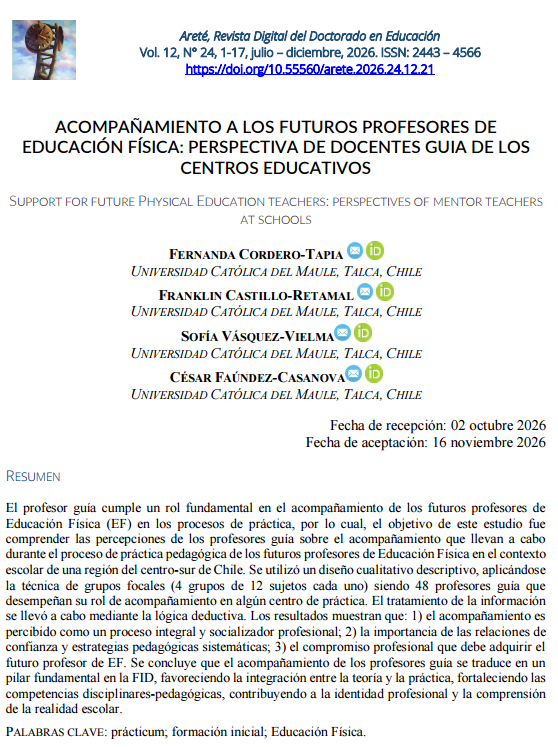
Support for future Physical Education teachers: perspectives of mentor teachers at schools
DOI:
https://doi.org/10.55560/arete.2026.24.12.21Keywords:
practicum, initial training, Physical EducationAbstract
The mentoring teacher plays a fundamental role in supporting future physical education (PE) teachers during their teaching practicum in schools. Therefore, the objective of this study was to understand the perceptions of mentoring teachers regarding the support they provide during the teaching practicum of future physical education teachers in the school context of a region in south-central Chile. To this end, a descriptive qualitative design was used, employing the focus group technique (4 groups of 12 participants each), involving 48 supervising teachers who perform their supervisory role at a practicum site. Data analysis was conducted using deductive analysis. The results show that: 1) mentoring is perceived as a comprehensive process that fosters professional socialization; 2) the importance of trusting relationships and systematic pedagogical strategies; 3) the professional commitment that future PE teachers must develop. It is concluded that the mentoring provided by supervising teachers serves as a fundamental pillar of initial teacher education, fostering the integration of theory and practice, strengthening disciplinary and pedagogical competencies, and contributing to professional identity and an understanding of the school environment.
References
Agiasotelis, E., Dania, A., Karteroliotis, K., & Giossos, Y. (2025). The Impact of Practicum Experiences on Preservice Physical Education Teachers’ Self-Efficacy. International Journal of Physical Education, Fitness and Sports, 12(4). https://doi.org/10.54392/ijpefs2522
Asociación Médica Mundial (AMM). (2024). Declaración de Helsinki de la AMM. Principios éticos para las investigaciones médicas en seres humanos. https://url.ucm.cl/WkYd4N
Bastías Bastías, L. S., & Iturra-Herrera, C. (2023). La formación práctica de los futuros profesoras(es) de Pedagogía en Educación Básica en Chile: Definiciones y temas pendientes en la normativa institucional en torno a la articulación universidad-escuela. Revista Mexicana de Investigación Educativa, 28(99), 1103-1132. https://www.scielo.org.mx/scielo.php?script=sci_arttext&pid=S1405-66662023000401103
Benavides-Lara, M. A., Pompa Mansilla, M., de Agüero Servín, M., Sánchez-Mendiola, M., & Rendón Cazales, V. J. (2022). Los grupos focales como estrategia de investigación en educación: algunas lecciones desde su diseño, puesta en marcha, transcripción y moderación. CPU-E, Revista De Investigación Educativa, 34. https://doi.org/10.25009/cpue.v0i34.2793
Cáceres, P. (2008). Análisis cualitativo de contenido: una alternativa metodológica alcanzable. Psicoperspectivas, 2(1), 53-82. https://doi.org/10.5027/psicoperspectivas-Vol2-Issue1-fulltext-3
Carless, D., & Boud, D. (2018). El desarrollo de la alfabetización en retroalimentación estudiantil: facilitando la adopción de la retroalimentación. Assessment & Evaluation in Higher Education, 43(8), 1315-1325. https://doi.org/10.1080/02602938.2018.1463354
Casas-Ernst, Jacqueline Alejandra, Mujica-Stach, Ana Milena, Elzel-Castro, Luisa Magaly, Bergma-Álvarez, María José, & Moreno Schmidt, Gladys Janette. (2022). Práctica profesional: Una mirada de los docentes que orientan el quehacer educativo. Revista Internacional de Investigación en Ciencias Sociales, 18(2), 313-328. https://doi.org/10.18004/riics.2022.diciembre.313
Comision Nacional del Acreditación. (2023). Criterios y estándares de calidad para la acreditación institucional de Universidades. CNA-Chile. https://www.cnachile.cl/noticias/paginas/nuevos_cye.aspx
Cresswell JW. & Plano Clark VL. (2011). Diseño y realización de investigación con métodos mixtos. Sage.
Creswell, J. W. & Poth, Ch. N. (2018). Qualitative Inquiry and Research Design. Choosing Among Five Approaches. Sage.
Dreer-Goethe B. (2025). The impact of mentor support and high-quality connections on student teachers’ psychological safety and engagement during practicum. Front. Educ, 10, 1499749. https://doi.org/10.3389/feduc.2025.1499749
Fierro-Saldaña, B., & Velásquez-Salazar, A. (2026). Acompañar para formar: experiencias y sentido de los profesores colaboradores en las prácticas de Educación Física. Retos, 74, 880-890. https://doi.org/10.47197/retos.v74.118113
Flores Gómez, C., Perez Quintero, J. F., & Villalobos Vergara, P. (2023). Rol del profesor colaborador en contextos de práctica profesional, desde la voz de sus protagonistas. Revista Sophia Austral, 29(1), 1-22. https://doi.org/10.22352/SAUSTRAL20232901
García Van Rysselberghe, I., & Osorio Herrera, A. M. (2026). Retroalimentación entre pares en la formación inicial docente: Un modelo praxeológico. Estudios Pedagógicos, 52(1), 89-110. https://doi.org/10.69850/rimi.vi1.204
Goldshaft, B. (2024). Mentoring in practicum: supporting student teachers’ learning to notice with collaborative observational tools. Professional Development in Education, 52(4), 1-20. https://doi.org/10.1080/19415257.2024.2441837
Gomez Zaccarelli, F., Rojas-Avilez, L., & Guerrero Morales, P. (2026). School-University partnership in teacher education: the role of collaboration in constructing teacher identity during practicum. Teacher Development, 30(3), 613-632. https://doi.org/10.1080/13664530.2025.2554105
Hinojosa-Torres, C., Barahona-Fuentes, G., Zavala-Crichton, J. P., Fuentealba-Urra, S., Hurtado-Guerrero, M., Gajardo-Vergara, X. & Yáñez-Sepúlveda, R. (2025). Supervisión de prácticas en la formación inicial de profesores Educación Física: hallazgos, tensiones y propuestas de mejora. Revisión sistemática. Retos, 70, 742-758. https://doi.org/10.47197/retos.v70.115797
Johansson, E. (2024). Supervisors’ guidance of PETE students’ reflections at practicum: creating conditions for different learning journeys. Reflective Practice, 25(3), 441-454. https://doi.org/10.1080/14623943.2024.2321508
Kalsoom, T., Showunmi, V., & Ibrar, I. (2019). A Systematic Literature Review on the Role of Mentoring and Feedback in Improvement of Teaching Practicum. Sjesr, 2(2), 20-32. https://doi.org/10.36902/sjesr-vol2-iss2-2019(20-32)
Ley N°20.903. (2016). Crea el sistema de desarrollo profesional docente y modifica otras normas. Ministerio de educación, Chile. https://bcn.cl/27gm2
Lincoln, Y. S., & Guba, E. G. (1985). Naturalistic inquiry. Sage Publications.
Lindström, L., Löfström, E., & Londén, M. (2024). Supervising teachers’ orientations and conceptions about content and process in teaching. Educational Studies, 50(6), 1053-1070. https://doi.org/10.1080/03055698.2022.2028608
Lozano, M., Chávez Taipe, Y., & Sánchez Ortega, J. (2025). La mentoría en la educación superior: una revisión de la literatura. InveCom, 5(1). https://doi.org/10.5281/zenodo.12629762
Manterola, C. & Rivadeneira, J. (2025). Estrategias de Muestreo Disponibles para Aplicar en una Población en Estudio. International Journal of Morphology, 43(6), 2163-2175. https://dx.doi.org/10.4067/s0717-95022025000602163
Ministerio de Educación de Chile (2014). Estándares Orientadores para la Formación Inicial Docente en Educación Física. Santiago: MINEDUC. https://estandaresdocentes.mineduc.cl/wp-content/uploads/2021/08/Educacion-Fisica.pdf
Ministerio de Educación de Chile. (2025). Plan de acoplamiento: Adopción de los nuevos estándares de la profesión docente en la formación inicial. Centro de Perfeccionamiento, Experimentación e Investigaciones Pedagógicas (CPEIP). https://estandaresdocentes.mineduc.cl/wp-content/uploads/2026/05/plan_acoplamiento_2026-2.pdf
Moy, B., & Rossi, T. (2026). Supporting preservice teachers to implement an alternative physical education pedagogy on prácticum. Physical Education and Sport Pedagogy, 31(2), 191-204. https://doi.org/10.1080/17408989.2024.2304845
Mytchyk, O., Klish, I., Denysenko, N., Dyshko, O., Moroz, M. S., & Tarasjuk, V. (2025). Features of Pre-Graduation Teaching Practice in Physical Education in Secondary Schools. Scientific Journal of the Mykhailo Drahomanov Ukrainian State University. Series 15, 7(194), 152-155. https://doi.org/10.31392/UDU-nc.series15.2025.07(194).30
Navarro-Ibáñez, M. & Grau Cárdenas, V. (2026). Teacher self-efficacy and mentorship: Exploring the roles of Cooperating Teachers and University Supervisors in practicum experiences of preservice teachers. Teaching and Teacher Education, 176, 105531. https://doi.org/10.1016/j.tate.2026.105531
Nigate, D. A., Mihiretie, D. M., & Kassa, S. A. (2023). Mentoring during school practicum: Mentor-mentee relationship, roles assumed, and focus of feedback. International Journal of Work-Integrated Learning, 24(4), 491-503. https://share.google/34RjrYeJLI1jpXbwQ
Orland‐Barak, L., & Wang, J. (2021). Teacher mentoring in service of preservice teachers’ learning to teach: Conceptual bases, characteristics, and challenges for teacher education reform. Journal of Teacher Education, 72(1), 86-99. https://doi.org/10.1177/0022487119894230
Osorio-Carvajal, R. (2025). Evaluación formativa como praxis inacabada: complejidad, tensiones y justicia. Revista Estudios en Educación (REeED), 8(15), 184-204. https://share.google/eVkTjxlo4G6t9uZl3
Palinkas, L. A., Horwitz, S. M., Green, C. A., Wisdom, J. P., Duan, N., & Hoagwood, K. (2015). Purposeful Sampling for Qualitative Data Collection and Analysis in Mixed Method Implementation Research. Administration and policy in mental health, 42(5), 533-544. https://doi.org/10.1007/s10488-013-0528-y
Schilling Lara, C., Souza de Carvalho, R., Castillo Retamal, F., Pereda Soza, M., & Rojas Castro, C. (2025). Experiencias de aprendizaje práctico en la formación de profesionales de Educación Física en el contexto post-pandemia. Retos, 67, 391-405. https://doi.org/10.47197/retos.v67.109439
Simon, E. (2024). Cultivating Professional Identity: The Vital Role of Practical Teaching Experience for Future Educators. Education Sciences, 14(5), 439. https://doi.org/10.3390/educsci14050439
Taylor, S. J. & Bogdan, R. (1987). Introducción a los métodos cualitativos de investigación (Vol. 1). Paidós.
Trillo Alonso, F., Nieto Cano, J. M., Martínez Domínguez, B., & Escudero Muñoz, J. M. (2017). Professional development and teacher collaboration: Analyzing tensions and fractures between theory and practice in a Spanish context. Education Policy Analysis Archives, 25(117), 1-32. https://doi.org/10.14507/epaa.25.3316
Vásquez, S. A., Monsalve, M. E. O., & Castaño, J. P. M. (2025). Percepción de la práctica profesional en estudiantes y profesores universitarios de educación física. Journal of Posthumanism, 5(5), 5098-5109. https://doi.org/10.63332/joph.v5i5.2091
Published
How to Cite
Issue
Section
License
Copyright (c) 2026 Fernanda Cordero-Tapia, Franklin Castillo-Retamal, Sofía Vásquez-Vielma, César Faúndez-Casanova

This work is licensed under a Creative Commons Attribution-NonCommercial-NoDerivatives 4.0 International License.
This journal provides free, immediate access to its content under the principle of making research freely available to the public, which fosters a greater exchange of global knowledge.
Authors who publish in Areté, Revista Digital del Doctorado en Educación, agree to the following terms:
- Authors retain copyright and grant the journal the right to be the first publication of the work, as well as licensed under a Creative Commons Attribution License that allows others to share the work with an acknowledgement of authorship of the work and initial publication in this journal.
- Authors may separately establish additional agreements for the non-exclusive distribution of the version of the work published in the journal (for example, placing it in an institutional repository or publishing it in a book), with an acknowledgement of its initial publication in this journal and not to be used for commercial purposes.
- The contents and images included in the articles are the responsibility of the author(s). Areté, Revista Digital del Doctorado en Educación, is not responsible for the information included in them.
- Authors agree with the license of use used by the journal, with the self-archiving conditions and with the open access policy.
- Authors are allowed to disseminate electronically (e.g., in institutional repositories or on their own website) the published version of their work, as it favors its earlier circulation and dissemination and thus a possible increase in its citation and reach among the academic community.
- In case of reuse of published works, the existence and specifications of the license of use must be mentioned, as well as the authorship and original source of publication.