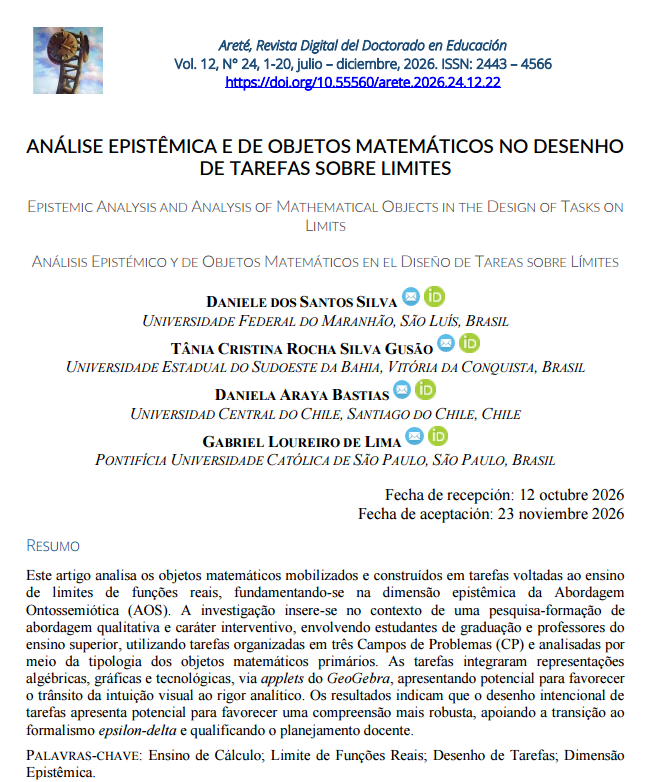
Epistemic Analysis and Analysis of Mathematical Objects in the Design of Tasks on Limits
DOI:
https://doi.org/10.55560/arete.2026.24.12.22Keywords:
Calculus Teaching, Limits of Real Functions, Task Design, Epistemic DimensionAbstract
This article analyzes the mathematical objects mobilized and constructed in tasks designed to teach limits of real-valued functions, drawing on the epistemic dimension of the Ontosemiotic Approach (OSA). The study is part of a qualitative, intervention-oriented research-training process involving undergraduate students and higher education teachers. The tasks were organized into three Problem Fields (PFs) and examined through the typology of primary mathematical objects. They integrated algebraic, graphical, and technological representations through GeoGebra applets, aiming to facilitate the transition from visual intuition to analytical rigor. The findings indicate that the intentional design of mathematical tasks has the potential to promote a more comprehensive conceptual understanding of limits, support the transition to epsilon-delta formalism, and enhance instructional planning.
References
Alla, X. (2024). Aprendizagem ao longo da vida. Revista Interdisciplinar de Pesquisa e Desenvolvimento, 11(1), 27. https://www.journal-uamd.org/index.php/IJRD/article/view/344
Araya, D. A. B. (2022). Diseño de tareas sobre los significados parciales de la noción de límite en funciones de una variable [Tese de doutorado, Universidad de Los Lagos]. https://edumat.ulagos.cl/wp-content/uploads/2022/08/Tesis-Doctorado-Daniela-Araya-Bastias_2022.pdf
Araya Bastias, D. A., & Pino-Fan, L. R. (2023). Componentes e indicadores para el diseño y reflexión de procesos de instrucción sobre límites de funciones en una variable. Paradigma, 44(4), 409–426. https://doi.org/10.37618/PARADIGMA.1011-2251.2023.p409-426.id1392
Arenas-Nina, C. E., Prieto-González, J. L., & Arredondo, E.-H. (2026). Diseño de tareas para el aprendizaje de la distribución binomial en estudiantes de enseñanza media. Areté, Revista Digital del Doctorado en Educación, 12(24), 1–25. https://doi.org/10.55560/arete.2026.24.12.2
Borba, M. C., & Araújo, J. L. (2010). Pesquisa qualitativa em educação matemática (3ª ed.). Autêntica.
Breda, A., Bolondi, G., & Abreu Silva, R. (2021). Enfoque ontossemiótico da cognição e instrução matemática: Um estudo metanalítico das teses produzidas no Brasil. Revemop, 3, e202117. https://doi.org/10.33532/revemop.e202117
Fonseca, V., & Henriques, A. (2018). Compreensão da definição formal de limite: Um estudo na formação inicial de professores de matemática. Bolema: Boletim de Educação Matemática, 32(62), 1030–1049. https://doi.org/10.1590/1980-4415v32n62a14
Galindo Illanes, M. K., & Breda, A. (2024). Proceso de instrucción de la derivada aplicado a estudiantes de ingeniería comercial en Chile. Uniciencia, 38(1), 303–325. https://doi.org/10.15359/ru.38-1.17
Galindo Illanes, M. K., Breda, A., & Alvarado Martinez, H. (2023). Diseño de un proceso de enseñanza de la derivada para estudiantes de ingeniería comercial en Chile. Paradigma, 44(4), 321–350. https://doi.org/10.37618/PARADIGMA.1011-2251.2023.p321-350.id1386
Godino, J. D. (2024). Enfoque ontosemiótico en educación matemática: Fundamentos, herramientas y aplicaciones. Editorial Aula Magna.
Godino, J. D., Font, V., Wilhelmi, M. R., & Lurduy, O. (2011). Why is the learning of elementary arithmetic concepts difficult? Semiotic tools for understanding the nature of mathematical objects. Educational Studies in Mathematics, 77(2–3), 247–265. https://doi.org/10.1007/s10649-010-9278-x
Gusmão, T. C. R. S., & Font, V. (2021). Ciclo de estudo e desenho de tarefas. Educação Matemática Pesquisa: Revista do Programa de Estudos Pós-Graduados em Educação Matemática, 22(3), 666–697. https://doi.org/10.23925/1983-3156.2020v22i3p666-697
Henriques, A., & Almouloud, S. A. (2016). Teoria dos registros de representação semiótica em pesquisas na educação matemática no ensino superior: Uma análise de superfícies e funções de duas variáveis com intervenção do software Maple. Ciência & Educação (Bauru), 22(2), 465–487. https://doi.org/10.1590/1516-731320160020012
Messias, M. A. de V. F., & Brandemberg, J. C. (2015). Discussões sobre a relação entre limite e continuidade de uma função: Investigando imagens conceituais. Bolema: Boletim de Educação Matemática, 29(53), 1224–1241. https://doi.org/10.1590/1980-4415v29n53a21
Moreira, C. B., Gusmão, T. C. R. S., & Moll, V. F. (2018). Tarefas matemáticas para o desenvolvimento da percepção de espaço na educação infantil: Potencialidades e limites. Bolema: Boletim de Educação Matemática, 32(60), 231–254. https://doi.org/10.1590/1980-4415v32n60a12
Motta, T. C., & Bragança, I. F. S. (2019). Pesquisaformação: Uma opção teoricometodológica de abordagem narrativa (auto)biográfica. Artes de dizerfazerdizer os saberes da experiência. Revista Brasileira de Pesquisa (Auto)biográfica, 4(12), 1034–1049. https://doi.org/10.31892/rbpab2525-426X.2019.v4.n12.p1034-1049
Pino-Fan, L. R. (2017). Contribución del enfoque ontosemiótico a las investigaciones sobre didáctica del cálculo. In Actas del Segundo Congreso Internacional Virtual sobre el Enfoque Ontosemiótico del Conocimiento y la Instrucción Matemáticos (pp. 1–16).
Silva, R. de A., Felicetti, V. L., Backes, L., & Breda, A. (2023). Abordagem ontossemiótica da cognição e instrução matemática: Formação continuada nas produções de mestrado e doutorado no Brasil (2016–2020). Revista Paradigma, 44, 269–292.
Silva, D. dos S., Gusmão, T. C. R. S., & Breda, A. (2026). Gestão de tarefas no ensino de limites de funções reais no ensino superior. Educação Matemática Pesquisa: Revista do Programa de Estudos Pós-Graduados em Educação Matemática, 28, 1–41. https://doi.org/10.23925/1983-3156.2026.v28.e73447
Silva, D. S., Gusmão, T. C. R. S., Souza, G. M., & Assis, E. S. (2025). Ensino de limite de funções de uma variável real: Uma revisão sistemática de literatura explorando dificuldades, desafios e a implementação de tarefas. Alexandria: Revista de Educação em Ciência e Tecnologia, 18, 1–36. https://doi.org/10.5007/1982-5153.2025.e100777
Sousa, J. R. de, & Gusmão, T. C. R. S. (2024). Contribuições do (re)desenho de tarefas para a formação de professores de matemática. Bolema: Boletim de Educação Matemática, 38. https://doi.org/10.1590/1980-4415v38a220049
Published
How to Cite
Issue
Section
License
Copyright (c) 2026 Daniele dos Santos Silva, Tânia Cristina Rocha Silva Gusmão, Daniela Andrea Araya Bastias, Gabriel Loureiro de Lima

This work is licensed under a Creative Commons Attribution-NonCommercial-NoDerivatives 4.0 International License.
This journal provides free, immediate access to its content under the principle of making research freely available to the public, which fosters a greater exchange of global knowledge.
Authors who publish in Areté, Revista Digital del Doctorado en Educación, agree to the following terms:
- Authors retain copyright and grant the journal the right to be the first publication of the work, as well as licensed under a Creative Commons Attribution License that allows others to share the work with an acknowledgement of authorship of the work and initial publication in this journal.
- Authors may separately establish additional agreements for the non-exclusive distribution of the version of the work published in the journal (for example, placing it in an institutional repository or publishing it in a book), with an acknowledgement of its initial publication in this journal and not to be used for commercial purposes.
- The contents and images included in the articles are the responsibility of the author(s). Areté, Revista Digital del Doctorado en Educación, is not responsible for the information included in them.
- Authors agree with the license of use used by the journal, with the self-archiving conditions and with the open access policy.
- Authors are allowed to disseminate electronically (e.g., in institutional repositories or on their own website) the published version of their work, as it favors its earlier circulation and dissemination and thus a possible increase in its citation and reach among the academic community.
- In case of reuse of published works, the existence and specifications of the license of use must be mentioned, as well as the authorship and original source of publication.