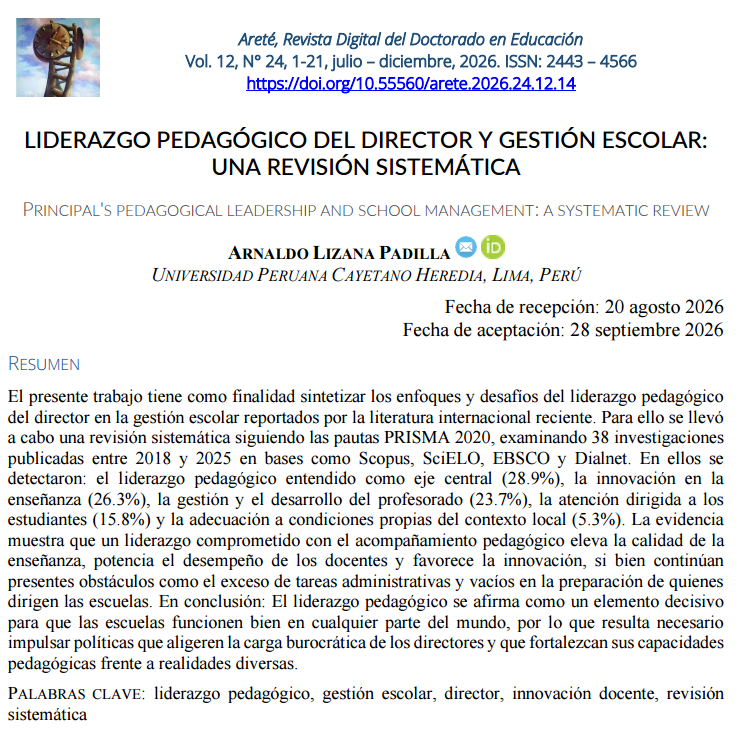
Principal's pedagogical leadership and school management: a systematic review
DOI:
https://doi.org/10.55560/arete.2026.24.12.14Keywords:
pedagogical leadership, school management, principal, teaching innovation, systematic reviewAbstract
This paper aims to synthesize the approaches and challenges of principals' pedagogical leadership in school management reported by recent international literature. A systematic review was conducted following PRISMA 2020 guidelines, examining 38 studies published between 2018 and 2025 in databases such as Scopus, SciELO, EBSCO, and Dialnet. Five predominant research lines were identified: pedagogical leadership as a central construct (28.9%), teaching innovation (26.3%), teacher management and development (23.7%), student engagement (15.8%), and adaptation to local contextual conditions (5.3%). The evidence shows that leadership committed to pedagogical support enhances teaching quality, strengthens teacher performance, and promotes innovation; however, obstacles such as administrative overload and gaps in principal preparation persist. In conclusion, pedagogical leadership is confirmed as a decisive element for effective school functioning worldwide, making it necessary to promote policies that reduce principals' bureaucratic burden and strengthen their pedagogical capacities to respond to diverse realities.
References
Ambon, J., Alias, B. S., & Mansor, A. N. (2025). A significant systematic review: Impact of school head leadership competencies on teacher development. International Journal of Evaluation and Research in Education. https://api.semanticscholar.org/CorpusID:274215527
Bellibaş, M. S., Gümüs, S., & Liu, Y. (2021). Does school leadership matter for teachers' classroom practice? The influence of instructional leadership and distributed leadership on instructional quality. School Effectiveness and School Improvement, 32(3), 387-412. https://doi.org/10.1080/09243453.2020.1858119
Berhanu, K. (2025). Development and validation of pedagogical leadership scale. International Journal of Educational Management, 39(8), 77-97. https://doi.org/10.1108/IJEM-04-2023-0168
Boland, A., Cherry, G., & Dickson, R. (2017). Doing a systematic review: A student's guide. Sage Publications.
Bujang, M., Alias, B. S., & Mansor, A. N. (2025). Fomento de la integridad en el liderazgo ético de directores escolares: Una revisión sistemática exhaustiva. International Journal of Evaluation and Research in Education, 14(2), 1034-1043. https://doi.org/10.11591/ijere.v14i2.30993
COPE Council. (2024). COPE position - Authorship and AI tools - English. Committee on Publication Ethics. https://publicationethics.org/guidance/cope-position/authorship-and-ai-tools
Dexter, S., Moraguez, D., & Clement, D. (2022). Pedagogical gaps in the bridge from classroom to field for pre-service principal competence development. Journal of Educational Administration, 60(5), 473-492. https://doi.org/10.1108/JEA-07-2021-0141
Dutta, V., & Sahney, S. (2021). Relation of principal instructional leadership, school climate, teacher job performance and student achievement. Journal of Educational Administration, 60(2), 148-166. https://doi.org/10.1108/JEA-01-2021-0010
García Zambrano, L. I. (2026). Inclusión educativa y liderazgo escolar: revisión narrativa sobre el rol de docentes y directivos. Polo del Conocimiento, 11(3), 11447.
García, H. (2021). Análisis del modelo de gestión escolar en instituciones educativas públicas multigrado de San Ignacio, Perú. Revista Educación, 45(1), 1-15. https://doi.org/10.15517/revedu.v45i1.40537
Ismail, M., Khatibi, A. A., & Azam, S. M. F. (2020). The mediating effect of school culture in the relationship between deputy principal's instructional leadership and school effectiveness in government schools in Maldives. Malaysian Online Journal of Educational Management, 8(2), 45-62. http://ijeas.um.edu.my/index.php/MOJEM/article/view/27959
Jerdborg, S. (2023). Novice school principals in education and their experiences of pedagogical leadership in practice. Journal of Leadership Education, 22(1), 131-148. https://doi.org/10.12806/V22/I1/R8
Kalkan, Ü., Altınay Aksal, F., Altınay Gazi, Z., Atasoy, R., & Dağlı, G. (2020). The relationship between school administrators' leadership styles, school culture, and organizational image. Sage Open, 10(1), 2158244020902081. https://doi.org/10.1177/2158244020902081
Kilag, O., & Sasan, J. (2023). Unpacking the role of instructional leadership in teacher professional development. Advanced Qualitative Research, 1(1), 63-82. https://doi.org/10.31098/aqr.v1i1.1380
Lazcano, C., Guerrero, P., & Volante, P. (2022). Influencia del liderazgo educativo en la retención docente. Revista Internacional de Liderazgo en Educación, 28(5), 567-582. https://doi.org/10.1080/13603124.2022.2066187
Liu, Y., & Zhang, X. (2024). Unboxing the black box: How principal's regulatory focus shapes teacher innovative pedagogies. Teaching and Teacher Education, 148, 104692. https://doi.org/10.1016/j.tate.2024.104692
Moreno, L. M., Dioses, L. A., Guerrero, H. I., Calderón, D., & Fuster, D. (2024). El liderazgo pedagógico y la experiencia educativa de estudiantes con discapacidad. Revista InveCom, 4(2), 45-58. https://doi.org/10.5281/zenodo.10839486
Muñoz Valles, A. S. (2026). Implicancias del liderazgo pedagógico: Una revisión sistemática. Revista Tribunal, 6(14), 865-878. https://doi.org/10.59659/revistatribunal.v6i14.363
OREALC/UNESCO Santiago. (2014). Liderazgo escolar en América Latina y el Caribe: Experiencias innovadoras de formación de directivos escolares en la región. UNESCO. https://unesdoc.unesco.org/ark:/48223/pf0000244075
Page, M. J., McKenzie, J. E., Bossuyt, P. M., Boutron, I., Hoffmann, T. C., Mulrow, C. D., Shamseer, L., Tetzlaff, J. M., Akl, E. A., Brennan, S. E., Chou, R., Glanville, J., Grimshaw, J. M., Hróbjartsson, A., Lalu, M. M., Li, T., Loder, E. W., Mayo-Wilson, E., McDonald, S., … Moher, D. (2021). The PRISMA 2020 statement: An updated guideline for reporting systematic reviews. Journal of Clinical Epidemiology, 134, 178-189. https://doi.org/10.1016/j.jclinepi.2021.03.001
Pekkolay, S., & Ihl, K. S. S. (2021). Effective school management. Journal of Advances in Education and Philosophy, 5(8), 234-245.
Porras, D., & Duche, A. (2023). Transformational leadership and pedagogical management in basic education teachers in Peru: A case study. An International Multidisciplinary Online Journal, 3(11), 89-102. https://thercsas.com/wp-content/uploads/2023/11/rcsas3112023006.pdf
Puican, V. H., Gomez, A. J., Rimapa, L. R., Salvador, C. E., Espinoza, L. V., & Hernandez, O. H. (2023). Pedagogical leadership in the educational management of Peruvian educational institutions. International Journal of Professional Business Review, 8(4), 1-34. https://doi.org/10.26668/businessreview/2023.v8i4.5643
Raymundo, Y., Blancas, H. F., Roque, I. L., Hinojo, G. N., & Tazzo, M. M. (2023). Liderazgo directivo en la enseñanza virtual en una institución educativa del Perú, 2022. Horizontes: Revista de Investigación en Ciencias de la Educación, 7(31), 2510-2525. https://doi.org/10.33996/revistahorizontes.v7i31.681
Rojas, L. L., Orejón, M., Cuya, N., & Rivera, W. (2024). Liderazgo directivo y desempeño docente: Un análisis en el contexto educativo andino. Universidad Nacional San Cristóbal de Huamanga, 30, 59-71. https://dialnet.unirioja.es/servlet/articulo?codigo=10241839
Roque, E. O., Yucra, T., Achata, C. A., Fura, Y. M., Aguilar, R. A., & Rosales, J. (2025). Liderazgo directivo y motivación docente en las escuelas de la ciudad de Quillabamba. Revista Tribunal, 5(12), 829-838. https://doi.org/10.59659/revistatribunal.v5i12.240
Solin Muñoz, A. (2026). Implicancias del liderazgo pedagógico: Una revisión sistemática. Revista Tribunal, 6(14), 865-878. https://doi.org/10.59659/revistatribunal.v6i14.363
Striepe, M., & Cunningham, C. (2021). Understanding educational leadership during times of crises: A scoping review. Journal of Educational Administration, 60(2), 133-147. https://doi.org/10.1108/JEA-03-2021-0057
UNESCO. (2024). Reunión Mundial sobre la Educación 2024. Organización de las Naciones Unidas para la Educación, la Ciencia y la Cultura. https://acortar.link/Ho6Cjy
UNESCO. (2025). Liderazgo en la educación: Liderar para aprender. Informe de Seguimiento de la Educación en el Mundo. https://unesdoc.unesco.org/ark:/48223/pf0000389872
Valdés, R., & Urra, S. (2025). El liderazgo y la educación inclusiva desde la perspectiva de estudiantes y familias. EDUCAR, 61(2), 527-542. https://doi.org/10.5565/rev/educar.2399
Vaillant, D. (2015). Liderazgo escolar, evolución de políticas y prácticas y mejora de la calidad educativa. UNESCO. https://unesdoc.unesco.org/ark:/48223/pf0000232403_spa
Zhang, D., Fang, Z., & Liao, M. (2024). The impact of teacher's pedagogical leadership on student achievement: The mediating role of teaching methods. Journal of Professional Capital and Community, 9(4), 398-430. https://doi.org/10.1108/JPCC-11-2023-0074
Published
How to Cite
Issue
Section
License
Copyright (c) 2026 Arnaldo Lizana Padilla

This work is licensed under a Creative Commons Attribution-NonCommercial-NoDerivatives 4.0 International License.
This journal provides free, immediate access to its content under the principle of making research freely available to the public, which fosters a greater exchange of global knowledge.
Authors who publish in Areté, Revista Digital del Doctorado en Educación, agree to the following terms:
- Authors retain copyright and grant the journal the right to be the first publication of the work, as well as licensed under a Creative Commons Attribution License that allows others to share the work with an acknowledgement of authorship of the work and initial publication in this journal.
- Authors may separately establish additional agreements for the non-exclusive distribution of the version of the work published in the journal (for example, placing it in an institutional repository or publishing it in a book), with an acknowledgement of its initial publication in this journal and not to be used for commercial purposes.
- The contents and images included in the articles are the responsibility of the author(s). Areté, Revista Digital del Doctorado en Educación, is not responsible for the information included in them.
- Authors agree with the license of use used by the journal, with the self-archiving conditions and with the open access policy.
- Authors are allowed to disseminate electronically (e.g., in institutional repositories or on their own website) the published version of their work, as it favors its earlier circulation and dissemination and thus a possible increase in its citation and reach among the academic community.
- In case of reuse of published works, the existence and specifications of the license of use must be mentioned, as well as the authorship and original source of publication.