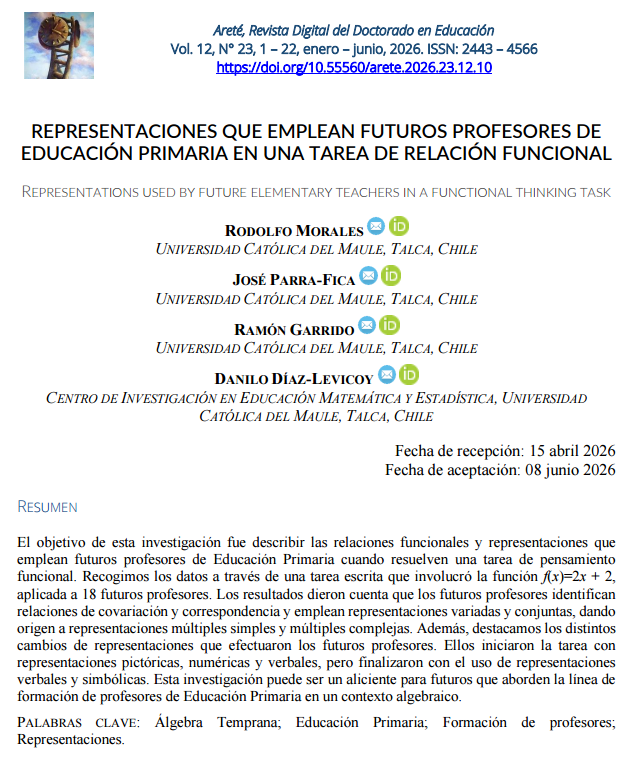
Representations used by future elementary teachers in a functional thinking task
DOI:
https://doi.org/10.55560/arete.2026.23.12.10Keywords:
Early Algebra, Primary Education, Teacher Training, RepresentationsAbstract
The aim of this study was to describe the functional relationships and representations used by prospective primary school teachers when solving a functional thinking task. Data were collected through a written task involving the function f(x)=2x + 2, administered to 18 prospective teachers. The results showed that prospective teachers identified both covariational and correspondence relationships and employed varied and combined representations, giving rise to simple multiple and complex multiple representations. In addition, we highlight the different representational changes made by the prospective teachers throughout the task. They began the task using pictorial, numerical, and verbal representations, but finished using mainly verbal and symbolic representations. This study may encourage future research focused on the preparation of prospective primary school teachers within an algebraic context.
References
Aké, L.P. (2021). El carácter algebraico en el conocimiento matemático de maestros en formación. Tecné, Episteme y Didaxis: TED, 49, 15-34. https://doi.org/10.17227/ted.num49-9871
Amit, M. y Neria, D. (2008). “Rising to the challenge”: Using generalization in pattern problems to unearth the algebraic skills of talented pre-algebra students. ZDM, 40(1), 111-129.
Ball, D., Thames, M. y Phelps, G. (2008). Content knowledge for teaching: What makes it special. Journal of teacher education, 59(5), 389-407.
Blanton, M. y Kaput, J. (2005). Characterizing a classroom practice that promotes algebraic reasoning. Journal for Research in Mathematics Education, 36(5), 412-446.
Blanton, M., Levi, L., Crites, T. y Dougherty, B. (2011). Developing essential understanding of algebraic thinking for teaching mathematics in grades 3-5. National Council of Teachers of Mathematics.
Blanton, M., Stephens, A., Knuth, E., Gardiner, A. M., Isler, I. y Kim, J. S. (2015). The development of children's algebraic thinking: The impact of a comprehensive early algebra intervention in third grade. Journal for research in Mathematics Education, 46(1), 39-87.
Blanton, M. L., Brizuela, B. M., Gardiner, A., Sawrey, K. y Newman-Owens, A. (2015). A learning trajectory in 6-year-olds’ thinking about generalizing functional relationships. Journal for Research in Mathematics Education, 46(5), 511-558.
Brizuela, B. (2024). Una mirada sobre el aprendizaje del álgebra en niños en niveles parvulario y básico desde los sistemas notacionales. Revista Chilena de Educación Matemática, 16(1), 3-11. https://doi.org/10.46219/rechiem.v16i1.160
Brizuela, B. y Blanton, M. (2014). El desarrollo del pensamiento algebraico en niños de escolaridad primaria. Revista de Psicología (UNLP), 14, 37-57.
Brizuela, B., Blanton, M., Gardiner, A. M., Newman-Owens, A. y Sawrey, K. (2015). A first grade student’s exploration of variable and variable notation. Estudios de Psicología, 36(1), 138-165.
Cañadas, M., Brizuela, B. M. y Blanton, M. (2016). Second graders articulating ideas about linear functional relationships. The Journal of Mathematical Behavior, 41, 87-103.
Cañadas, M. C. y Castro, E. (2007). A proposal of categorisation for analysing inductive reasoning. PNA, 1(2), 69-81.
Cañadas, M. C. y Figueiras, L. (2011). Uso de representaciones y generalización de la regla del producto. Infancia y Aprendizaje, 34(4), 409-425.
Cañadas, M. C. y Molina, M. (2016). Una aproximación al marco conceptual y principales antecedentes del pensamiento funcional en las primeras edades. En E. Castro, E. Castro, J. L. Lupiáñez, J. F. Ruíz y M. Torralbo (Eds.), Investigación en Educación Matemática. Homenaje a Luis Rico (pp. 209-218). Comares.
Carraher, D.W., Martinez, M. y Schliemann, A.D. (2008). Early algebra and mathematical generalization. ZDM The International Journal on Mathematics Education 40(1), 3-22.
Castro, E. (1995). Exploración de patrones numéricos mediante configuraciones puntuales. Comares.
Castro, E. y Castro, E. (1997). Representaciones y modelización. En L. Rico (Ed.), La Educación Matemática en la enseñanza secundaria (pp. 95-124). Horsori.
Cetina-Vázquez, M. y Cabañas-Sánchez, G. (2022). Estrategias de generalización de patro-nes y sus diferentes formas de uso en quinto grado. Enseñanza de las Ciencias, 40(1), 65-86. https://doi.org/10.5565/rev/ensciencias.3096
Clapham, C. (1998). Diccionario de matemáticas. Universidad de Complutense.
Gómez, B. (2016). Sobre el análisis didáctico de la razón. En E. Castro, E. Castro, J. L. Lupiáñez, J. F. Ruíz y M. Torralbo (Eds.), Investigación en Educación Matemática. Homenaje a Luis Rico (pp. 165-174). Comares.
Hernández, R., Fernández, C. y Baptista, P. (2007). Fundamentos de metodología de la investigación. Mcgraw-Hill.
Kaput, J. (2000). Transforming algebra from an engine of inequity to an engine of mathematical power by “algebrafying” the K-12 curriculum. National Center for Improving Student Learning and Achievement in Mathematics and Science.
Kieran, C. (2017). Teaching and learning algebraic thinking with 5-to 12-year-old: The global evolution of an emerging field of research and practice. Springer.
Lins, R. y Kaput, J. (2004). The early development of algebraic reasoning: the current state of the field. En K. Stacey, H. Chick y M. Kendal (Eds.), The teaching and learning of algebra. The 12th ICMI Study (pp.47-70). Kluwer Academic Publishers.
Mason, J. (1996). Expressing generality and roots of algebra. En N. Bernarz, C. Kieran y L. Lee (Eds.), Approaches to algebra (pp. 65-86). Springer.
Merino, E., Cañadas, M. y Molina, M. (2013). Uso de representaciones y patrones por alumnos de quinto de Educación Primaria en una tarea de generalización. Edma 0-6: Educación Matemática en la Infancia, 2(1), 24-40.
Ministerio de Educación de Chile (2012a). Bases curriculares de matemática educación básica. MINEDUC.
Ministerio de Educación de Chile (2012b). Estándares Orientadores para egresados de carreras de pedagógica en educacicón básica. MINEDUC.
Ministerio de Educación de Chile (2020). Informe de resultados nacionales: Evaluación Nacional Diagnóstica de la Formación Inicial Docente. Centro de Perfeccionamiento, Experimentación e Investigaciones Pedagógicas (CPEIP).
Molina, M. (2009). Una propuesta de cambio curricular: integración del pensamiento algebraico en educación primaria. PNA, 3(3), 135-156.
Morales, R., Cañadas, M. C., Brizuela, B. y Gómez, P. (2018). Relaciones funcionales y estrategias de alumnos de primero de educación primaria en un contexto funcional. Enseñanza de las Ciencias, 36(3), 59-78. https://doi.org/10.5565/rev/ensciencias.2472
Morales, R, y Parra-Fica, J. (2022). Estrategias que emplean futuros profesores de Educación Primaria en una tarea de relación funcional. Acta Sci. (Canoas), 24(3), 32-62. https://doi.org/10.17648/acta.scientiae.6959
Moss, J. y Beatty, R. (2006). Knowledge building in mathematics: Supporting collaborative learning in pattern problems. Computer-Supported Collaborative Learning, 1, 441-465.
Pang, J. y Sunwoo, J. (2022). An analysis of teacher knowledge for teaching functional thinking to elementary school students. Asian Journal for Mathematics Education, 1(3), 306-322. https://doi.org/10.1177/27527263221125112
Polo-Blanco, I., Oliveira, H. y Henriques, A. (2019). Portuguese and Spanish prospective teachers’ functional thinking on geometric patterns. En U. T. Jankvist, M. van den Heuvel-Panhuizen y M. Veldhuis (Eds.), Proceedings of the Eleventh Congress of the European Society for Research in Mathematics Education (pp. 670-671). Freudenthal Group & Freudenthal Institute, Utrecht University and ERME.
Pinto, E., y Cañadas, M. C. (2018). Generalization in fifth graders within a functional approach. PNA, 12(3), 173-184.
Radford, L. (2008). The ethics of being and knowing: Towards a cultural theory of learning. En L. Radford, G. Schubring, y F. Seeger (Eds.), Semiotics in mathematics education (pp. 215-234). Sense Publishers.
Rico, L. (1997). Consideraciones sobre el currículo de matemáticas para educación secundaria. En L. Rico (Coord.), La Educación Matemática en la enseñanza secundaria (pp. 15-38). Horsori.
Rico, L. (2006). La competencia matemática en PISA. PNA, 1(2), 47-66.
Rico, L. (2009). Sobre las nociones de representación y comprensión en la investigación en educación matemática. PNA, 4(1), 1-14.
Rodríguez-Domingo, S., Molina, M., Cañadas, M. y Castro, E. (2015). Errores en la traducción de enunciados algebraicos entre los sistemas de representación simbólico y verbal. PNA, 9(4), 273-293.
Sánchez, V., y Llinares, S. (2003). Four student teachers' pedagogical reasoning on functions. Journal of Mathematics Teacher Education, 6(1), 5-25.
Senk, S., Tatto, M., Reckase, M., Rowley, G., Peck, R. y Bankov, K. (2012). Knowledge of future primary teachers for teaching mathematics: An international comparative study. ZDM, 44(3), 307-324.
Smith, E. (2008). Representational thinking as a framework for introducing functions in the elementary curriculum. En J. Kaput, W. Carraher y M. Blanton (Eds), Algebra in the early grades (pp. 133-160). Routledge.
Strachota, S. (2016). Conceptualizing Generalization. Open Mathematical Education Notes. 6, 41-55.
Torres, M., Cañadas, M., Moreno, A. y Gómez, P. (2021). Estructuras en las formas directa e inversa de una función por estudiantes de 7-8 años. Uniciencia, 35(2), 1-16.
Wilkie, K. J. (2014). Upper primary school teachers’ mathematical knowledge for teaching functional thinking in algebra. Journal of Mathematics Teacher Education, 17(5), 397-428.
Published
How to Cite
Issue
Section
License
Copyright (c) 2026 Rodolfo Morales, José Parra-Fica, Ramón Garrido, Danilo Díaz-Levicoy

This work is licensed under a Creative Commons Attribution-NonCommercial-NoDerivatives 4.0 International License.
This journal provides free, immediate access to its content under the principle of making research freely available to the public, which fosters a greater exchange of global knowledge.
Authors who publish in Areté, Revista Digital del Doctorado en Educación, agree to the following terms:
- Authors retain copyright and grant the journal the right to be the first publication of the work, as well as licensed under a Creative Commons Attribution License that allows others to share the work with an acknowledgement of authorship of the work and initial publication in this journal.
- Authors may separately establish additional agreements for the non-exclusive distribution of the version of the work published in the journal (for example, placing it in an institutional repository or publishing it in a book), with an acknowledgement of its initial publication in this journal and not to be used for commercial purposes.
- The contents and images included in the articles are the responsibility of the author(s). Areté, Revista Digital del Doctorado en Educación, is not responsible for the information included in them.
- Authors agree with the license of use used by the journal, with the self-archiving conditions and with the open access policy.
- Authors are allowed to disseminate electronically (e.g., in institutional repositories or on their own website) the published version of their work, as it favors its earlier circulation and dissemination and thus a possible increase in its citation and reach among the academic community.
- In case of reuse of published works, the existence and specifications of the license of use must be mentioned, as well as the authorship and original source of publication.