Training of researchers: teaching principles from neuroeducation
DOI:
https://doi.org/10.55560/arete.2025.22.11.9Keywords:
Research training, research scientist, neuroeducation, didactics, mentoringAbstract
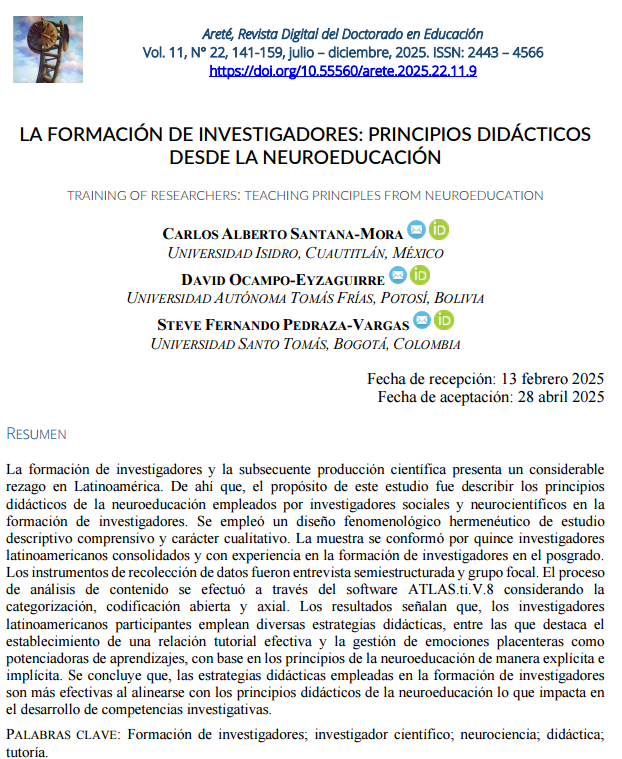
Researcher training and subsequent scientific production lags considerably behind in Latin America. Therefore, the purpose of this study was to describe the didactic principles of neuroeducation used by social researchers and neuroscientists in research training. A hermeneutic phenomenological design of comprehensive descriptive study and qualitative character was used. The sample consisted of fifteen consolidated Latin American researchers with experience in postgraduate research training. The data collection instruments were semi-structured interview and focus group. The content analysis process was carried out using ATLAS.ti.V.8 software, considering categorization, open and axial coding. The results indicate that the participating Latin American researchers use different didactic strategies, among which the establishment of an effective tutorial relationship and the management of pleasant emotions as learning enhancers, based on the principles of neuroeducation in an explicit and implicit manner, stand out. It is concluded that the didactic strategies used in the training of researchers are more effective when aligned with the didactic principles of neuroeducation, which has an impact on the development of research competencies.
References
Álvarez-Gayou, J. (2003). Cómo hacer investigación cualitativa. Fundamentos y metodología. Paidós.
Araya-Pizarro, S. y Espinoza-Pastén, L. (2020). Aportes desde las neurociencias para la comprensión de los procesos de aprendizaje en los contextos educativos. Propósitos y Representaciones, 8(1), e312. http://dx.doi.org/10.20511/pyr2020.v8n1.312
Babini, D. (2019). La comunicación científica en América Latina es abierta, colaborativa y no comercial. Desafíos para las revistas. Palabra Clave (La Plata), 8(2), e065. https://doi.org/10.24215/18539912e065
Bueno, D. (2019). Neurociencia para educadores. Octaedro.
Bueno, D. y Forés, A. (2021). Neurociència aplicada a l’educació. Com aprèn el cervell i quines conseqüències. Llengua, Societat i Comunicació, 19 (1), http://doi.org/10.1344/LSC-2021.19.5
Canquiz-Rincón, L., Inciarte-Romero, N. y Hurtado-Petit, C. (2023). Competencias en mediación cognitiva para la formación de investigadores. Revista de ciencias sociales, 29(8), 77-92.
Delgado-Bardales, J. M. (2021). La investigación científica: su importancia en la formación de investigadores. Ciencia Latina Revista Científica Multidisciplinar, 5(3), 2385-2386. https://doi.org/10.37811/cl_rcm.v5i3.476
Doherty A y Forés Miravalles A (2019) Physical Activity and Cognition: Inseparable in the Classroom. Front. Educ. 4:105. http://doi.org/10.3389/feduc.2019.00105
Fuster-Guillén, D. (2019). Investigación cualitativa: Método fenomenológico hermenéutico.
Propósitos y Representaciones, 7(1), 201-229. http://dx.doi.org/10.20511/pyr2019.v7n1.267
Fonseca Gutiérrez, J. (2020). La formación de investigadores: habilidades y conocimientos relevantes para los avances de la ciencia y la tecnología. CONDUCIR. Revista Iberoamericana de Investigación y Desarrollo Educativo, 10 (20), e019. https://doi.org/10.23913/ride.v10i20.621
Gago-Galvagno, L. y Elgier, A. (2018). Trazando puentes entre las neurociencias y la educación. Aportes, límites y caminos futuros en el campo educativo. Psicogente 21(40), 476-494. https://doi.org/10.17081/psico.21.40.3087
Jiménez-Chaves, V. (2015). La importancia del mentor en la formación del investigador. Academo, 2(1), 1-14.
Jiménez-Chaves, V. (2018). La formación de investigadores en la Universidad. Academo, 5(1), 1-2.
Kandel, E.; Schwartz, J. y Jessell, T. (2003). Neurociencia y conducta. Prentice Hall.
Lam-Díaz, R. (2016). La redacción de un artículo científico. Revista Cubana de Hematología, Inmunología y Hemoterapia, 32(1), 57-69.
Lozoya-Meza, E., Gutiérrez, S. y Lozoya-Ocegueda, R. (2018). La neurociencia cognitiva en la formación inicial de docentes investigadores educativos. Ciencia & Educación. 2 (3), 11-25. https://doi.org/10.22206/cyed.2018.v2i3.pp11-25
Martínez-Mora, S., Medina-Pinoargote, F., & Salazar-Carranza, L. (2018). Desarrollo de competencias investigativas en los estudiantes. Opuntia Brava, 10(1), 336-341. https://opuntiabrava.ult.edu.cu/index.php/opuntiabrava/article/view/80
Moreno-Bayardo, M. (2011). La formación de investigadores como elemento para la consolidación de la investigación en la universidad. Revista de la educación superior, 40 (158), 59-78.
Ocampo-Eyzaguirre, D., Vélez-Jiménez, D., & Gutiérrez-De Gracia, N. E. (2024). Tecnologías convergentes, inteligencia artificial y las neurociencias en la formación de investigadores: una revisión sistemática. Sociedad & Tecnología, 7(S1), 210–230. https://doi.org/10.51247/st.v7iS1.502
Organización de Estados Iberoamericanos [OEI] y la Organización de las Naciones Unidas
para la Educación, la Ciencia y la Cultura [UNESCO]. (2024). El estado de la Ciencia. Principales indicadores de ciencia y tecnología 2024. OEI-UNESCO. https://oei.int/wp-content/uploads/2024/12/el-estado-de-la-ciencia-2024.pdf
Paricahua-Peralta, J. N., Mora-Estrada, O., Isuiza-Pérez, D. D., Lazo-Herrera, T. A., y Atahuaman-Estrella, S. M. (2023). Neuroeducación en la práctica educativa y satisfacción en los estudiantes de una Universidad Pública Peruana. Universidad y Sociedad, 15(4), 413-420.
Pedraza-Longi, J. (2018). Experiencias de formación como investigadores educativos de estudiantes de un programa de doctorado en educación. Actualidades Investigativas en Educación, 18 (2), 136-169. https://dx.doi.org/10.15517/aie.v18i2.33134
Puerta-Lopera, I.; Montoya-Zuluaga, P.; Arango-Tobón, O. y Betancur-Arias, J. (2016). La forma de hacer y entender la investigación desde el grupo neurociencias básicas y aplicadas (NBA), Lámpsakos, 16 (1), 12-20. http://dx.doi.org/10.21501/21454086.2272
Quintero-Corzo, J., Ancízar-Munévar, R. y Munévar-Quintero, F. (2008). Semilleros de investigación: una estrategia para la formación de investigadores. Educación y Educadores, 11 (1), 31-42.
Reynosa-Navarro, E., Serrano-Polo E., Ortega-Parra, A., Navarro-Silva O., Cruz-Montero J. y Salazar-Montoya E. (2020). Estrategias didácticas para investigación científica: relevancia en la formación de investigadores. Universidad y Sociedad, 12(1), 259-266.
Sánchez- Lima, L., y Labarrete-Sarduy, A. F. (2015). Interacción estudiante-investigador. Relación pedagógica y profesional que sustenta la formación en el postgrado. Actualidades Investigativas En Educación, 15(2). https://doi.org/10.15517/aie.v15i2.18957
Sandín, M. (2003). Investigación Cualitativa en Educación. Fundamentos y tradiciones. Mc Graw Hill.
Santin, D., y Caregnato, S. (2020). Concentración y desigualdad científica en América Latina y el Caribe a principios del siglo XXI: Un estudio cienciométrico. Información, cultura y sociedad, (43), 13-30. https://dx.doi.org/10.34096/ics.i43.8131
Tapullima-Mori, C., Montalvo- Apolin, D., Bobadilla- Bautista, D. (2024). Estrategias didácticas en la asesoría de tesis para desarrollar competencias investigativas: perspectivas de docentes y estudiantes. Revista Digital de Investigación en Docencia Universitaria, 18(2), e1884. https://doi.org/10.19083/ridu.2024.1884
Vélez-Jiménez, D. y Pérez-Villafuerte, R. (2019). Filosofía y didáctica en la formación de investigadores. Laripse.
Vargas-Tipula, W., Zavala-Cáceres, E. y Zuñiga-Aparicio, P. (2024). Estrategias para aprender desde la neurociencia: revisión sistemática. Revista interdisciplinaria arbitrada Koinonia, 9 (Suppl. 1), 97-114. https://doi.org/10.35381/r.k.v9i1.3556
Zambrano-Sandoval, H. y Chacón Corzo, C. (2021). Competencias investigativas en la formación de posgrado. Análisis cualitativo. Revista Educación, 45 (2), 1-17. https://doi.org/10.15517/revedu.v45i1.43646
Published
How to Cite
Issue
Section
License
Copyright (c) 2025 Carlos Alberto Santana-Mora, David Ocampo-Eyzaguirre, Steve Fernando Pedraza-Vargas

This work is licensed under a Creative Commons Attribution-NonCommercial-ShareAlike 4.0 International License.
This journal provides free, immediate access to its content under the principle of making research freely available to the public, which fosters a greater exchange of global knowledge.
Authors who publish in Areté, Revista Digital del Doctorado en Educación, agree to the following terms:
- Authors retain copyright and grant the journal the right to be the first publication of the work, as well as licensed under a Creative Commons Attribution License that allows others to share the work with an acknowledgement of authorship of the work and initial publication in this journal.
- Authors may separately establish additional agreements for the non-exclusive distribution of the version of the work published in the journal (for example, placing it in an institutional repository or publishing it in a book), with an acknowledgement of its initial publication in this journal and not to be used for commercial purposes.
- The contents and images included in the articles are the responsibility of the author(s). Areté, Revista Digital del Doctorado en Educación, is not responsible for the information included in them.
- Authors agree with the license of use used by the journal, with the self-archiving conditions and with the open access policy.
- Authors are allowed to disseminate electronically (e.g., in institutional repositories or on their own website) the published version of their work, as it favors its earlier circulation and dissemination and thus a possible increase in its citation and reach among the academic community.
- In case of reuse of published works, the existence and specifications of the license of use must be mentioned, as well as the authorship and original source of publication.