Efectividad de las medidas preventivas de la transmisión vertical del virus de inmunodeficiencia humana Effectiveness of preventive measures of vertical transmission of human immunodeficiency virus
Barra lateral del artículo
Contenido principal del artículo
Resumen
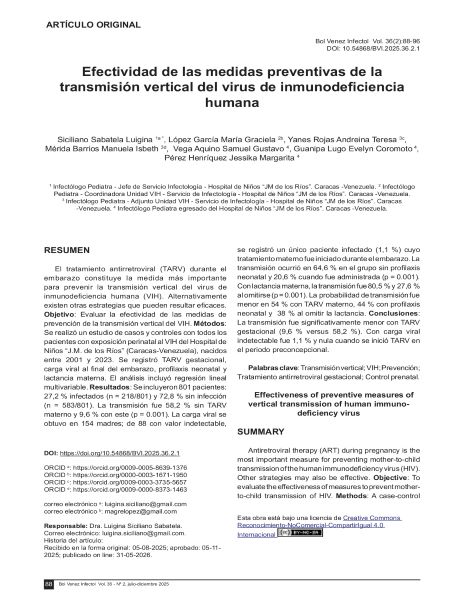
El tratamiento antirretroviral (TARV) durante el embarazo constituye la medida más importante para prevenir la transmisión vertical del virus de inmunodeficiencia humana (VIH). Alternativamente existen otras estrategias que pueden resultar eficaces. Objetivo: Evaluar la efectividad de las medidas de prevención de la transmisión vertical del VIH. Métodos: Se realizó un estudio de casos y controles con todos los pacientes con exposición perinatal al VIH del Hospital de Niños “J.M. de los Ríos” (Caracas-Venezuela), nacidos entre 2001 y 2023. Se registró TARV gestacional, carga viral al final del embarazo, profilaxis neonatal y lactancia materna. El análisis incluyó regresión lineal multivariable. Resultados: Se incluyeron 801 pacientes: 27,2 % infectados (n = 218/801) y 72,8 % sin infección (n = 583/801). La transmisión fue 58,2 % sin TARV materno y 9,6 % con este (p = 0.001). La carga viral se obtuvo en 154 madres; de 88 con valor indetectable, se registró un único paciente infectado (1,1 %) cuyo tratamiento materno fue iniciado durante el embarazo. La transmisión ocurrió en 64,6 % en el grupo sin profilaxis neonatal y 20,6 % cuando fue administrada (p = 0.001). Con lactancia materna, la transmisión fue 80,5 % y 27,6 % al omitirse (p = 0.001). La probabilidad de transmisión fue menor en 54 % con TARV materno, 44 % con profilaxis neonatal y 38 % al omitir la lactancia. Conclusiones: La transmisión fue significativamente menor con TARV gestacional (9,6 % versus 58,2 %). Con carga viral indetectable fue 1,1 % y nula cuando se inició TARV en el periodo preconcepcional.
Antiretroviral therapy (ART) during pregnancy is the most important measure for preventing mother-to-child transmission of the human immunodeficiency virus (HIV). Other strategies may also be effective. Objective: To evaluate the effectiveness of measures to prevent mother-to-child transmission of HIV. Methods: A case-control study was conducted with all patients with perinatal HIV exposure at the “J.M. de los Ríos” Children's Hospital (Caracas, Venezuela), born between 2001 and 2023. Gestational ART, viral load at the end of pregnancy, neonatal prophylaxis, and breastfeeding were recorded. The analysis included multivariable linear regression. Results: 801 patients were included: 27.2 % infected (n = 218/801) and 72.8 % uninfected (n = 583/801). Transmission occurred in 58.2 % of cases without maternal ART and 9.6 % with it (p = 0.001). Viral load was obtained from 154 mothers;
of the 88 with undetectable viral loads, only one infected patient (1.1 %) was recorded, whose maternal treatment was initiated during pregnancy. Transmission occurred in 64.6 % of the group without neonatal prophylaxis and in 20.6 % of the group with neonatal prophylaxis (p = 0.001). With breastfeeding, transmission was 80.5 %, and 27.6 % when breastfeeding was omitted (p = 0.001). The probability of transmission was 54 % lower with maternal ART, 44 % lower with neonatal prophylaxis, and 38 % lower when breastfeeding was omitted. Conclusions: Transmission was significantly lower with gestational ART (9.6 % versus 58.2 %). With undetectable viral load, transmission was 1.1 %, and zero when ART was initiated in the preconception period.
Descargas
Detalles del artículo

Esta obra está bajo una licencia internacional Creative Commons Atribución-NoComercial-CompartirIgual 4.0.